Partner managers know the feeling: you sit down to research a potential partner and an hour later you’re still switching between tabs, updating CRM records, and rewriting the same follow-up email you’ve sent a dozen times. The administrative load is real, and it compounds fast.
AI tools for partner managers won’t eliminate this work entirely, but the right stack can meaningfully reduce it.
We turned to Taylor Kendrick, Director of Partnerships at PartnerStack, to find out where AI is actually moving the needle. His take: “The mistake is automating activity instead of improving quality. AI should make you more targeted, not just more prolific.”
This article focuses on platform categories that support how partnership teams actually operate — not a bloated stack of apps you’ll abandon in a few months, but a practical AI toolkit for partner managers built around real workflows.

What partner managers need AI help with
The day-to-day of partner management breaks down into a few recurring categories of work — and each one is a place where AI can meaningfully cut down the busywork.
Research and account prep
Before a conversation even starts, partner managers are already deep in prep work — pulling company context, scanning for funding announcements, reviewing competitor positioning.
Kendrick calls pre-call research one of the highest-leverage AI use cases available today: “Research that used to take 30 minutes now takes two.”
Common use cases include:
- Researching companies and partner ecosystems
- Identifying growth signals and funding announcements
- Mapping competitor activity
- Reviewing existing partner relationships
- Preparing account summaries and meeting agendas
Meeting capture and follow-up
Meetings are a constant flow of information: next steps, action items, partner requests and strategy. Even the quickest typist in the west can’t capture all of that manually without something slipping through the cracks.
Kendrick flags post-call summaries and follow-up drafting as another of the highest-value AI applications today, helping partner managers spend less time documenting conversations — it’s “the other underrated one,” as he puts it.
Reporting, enablement and communication
Partner managers also spend significant time building reports, onboarding materials, internal documentation and recurring partner communications. These workflows are repetitive but necessary — which makes them exactly the kind of work AI workflow tools handle well.
You might also like: 8 creator program tools for B2B SaaS teams and when to use them.
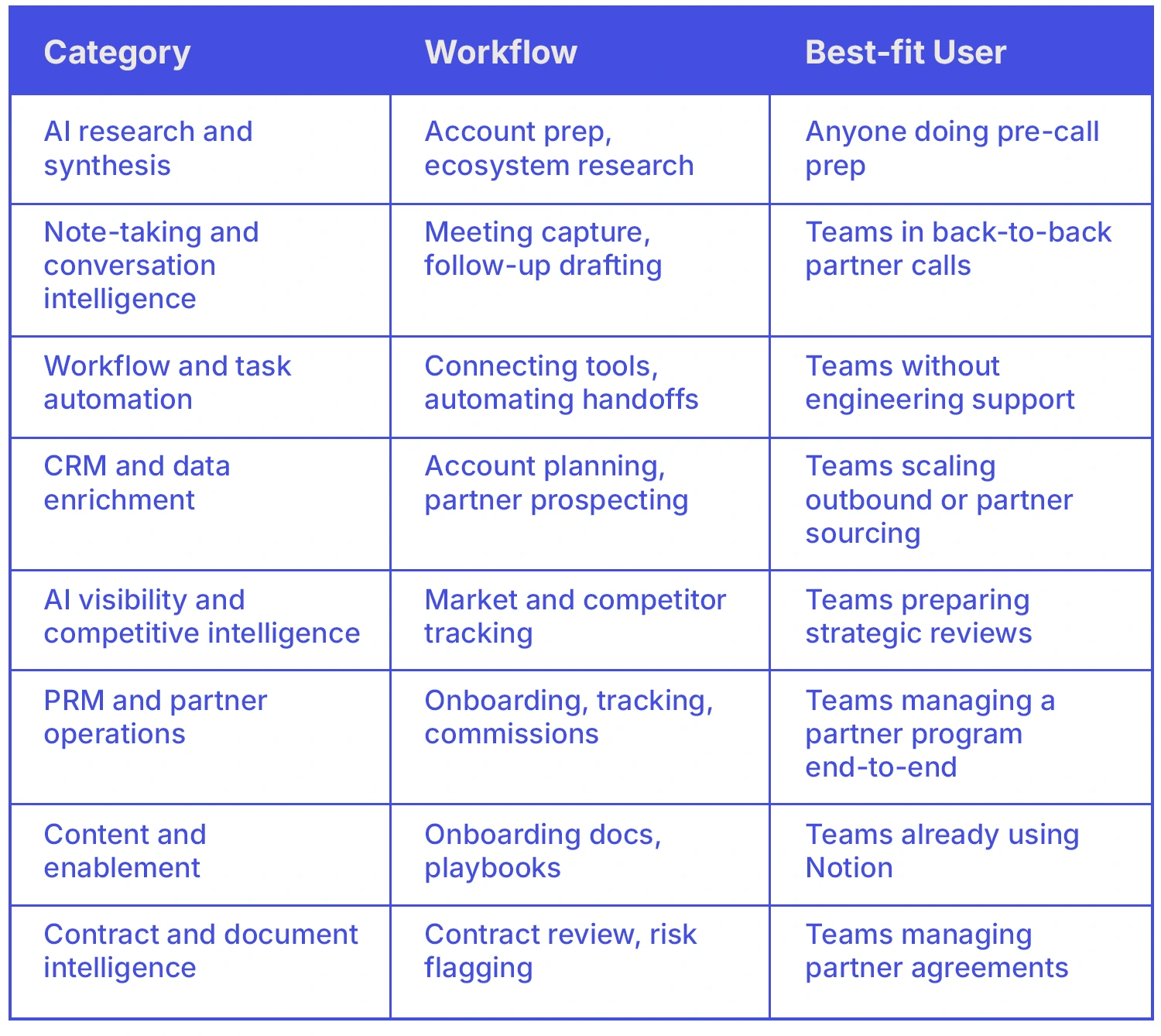
AI tools for partner managers: 8 platform categories worth looking at
Not every AI tool belongs in a partner manager’s stack. Kendrick recommends thinking in categories rather than individual tools. “The specific tools change too fast,” he says. “What matters is: do you have AI in your research layer, your communication layer, and your reporting layer? Find the best tool in each category for your stack, then commit.”
AI research and synthesis tools
For partner managers, AI research and synthesis tools mean faster account prep: company updates, funding announcements and competitive positioning condensed into minutes rather than a mess of open tabs. Kendrick puts pre-call research among the highest-leverage use cases available today, and this category delivers it quickly.
Use these tools for:
- Account preparation
- Ecosystem research
- Competitive scanning
- Market analysis
- Partner discovery
Consider: Perplexity
Perplexity is a strong starting point for partner research — it’s built for sourcing and synthesizing information quickly across the web rather than just generating text.
Other options: Claude, ChatGPT
Note-taking and conversation intelligence tools
Partner managers move fast between conversations. Without something capturing what was said, next steps get missed and follow-up drafts eat time that should go toward the next call.
This category automates the documentation layer entirely with:
- Meeting summaries
- Action-item tracking
- CRM updates
- Partner follow-up workflows
- Internal handoffs
Consider: Fathom
Fathom is a clean, easy-to-adopt option for meeting capture and follow-up automation, particularly useful for smaller teams who don’t need Gong’s full revenue intelligence suite.
Other options: Gong, Fireflies
Workflow and task-automation tools
Most partner managers are working across more systems than they should be. Workflow automation tools help connect those systems and handle the repetitive handoffs between them — so nothing falls through the cracks between your meeting tool, your CRM and your PRM.
Some common uses:
- Triggering partner onboarding workflows
- Updating CRM records automatically
- Routing leads between systems
- Creating tasks after meetings
- Automating notifications
Consider: Zapier
Zapier is an accessible entry point for teams without engineering resources — broad integration support and easy enough to set up without technical help.
Other options: Make, Relay
CRM and data-enrichment tools
Good partner management runs on good data. CRM and enrichment tools help teams consolidate account information, fill in gaps and maintain visibility across a growing partner program — without relying on manual data entry to keep everything current.
These tools support:
- Account planning
- Relationship mapping
- Partner prospecting
- Data enrichment
- Pipeline organization
Consider: Clay
Clay is strong for partner prospecting and outreach personalization. It pulls data from multiple sources and lets teams build enriched partner lists without a dedicated ops person.
Other options: Apollo, HubSpot
AI visibility and competitive-intelligence tools
Competitive intelligence tools surface market shifts, competitor moves and positioning changes automatically, instead of manual research and tracking. For partner managers, that means walking into account reviews and partner conversations already current on what’s changing in the market.
A newer, related category is worth watching too: GEO and AEO monitoring tools, which track how partners show up in AI-generated search results. Kendrick sees this as an emerging signal for partner quality: “If your partners aren't showing up in AI-generated answers, their referral value is quietly declining. Forward-thinking partner teams are already tracking citation presence as a leading indicator of partner quality.”
PartnerStack’s integration with Profound, for example, connects AI citation data directly to partner outreach — turning visibility insight into action rather than just a report to read.
These tools are valuable for:
- Monitoring competitor positioning
- Identifying market trends
- Tracking ecosystem changes
- Tracking partner citation presence in AI search results
- Preparing strategic account reviews
Consider: Crayon
Crayon is built for competitive intelligence — automated tracking of competitor messaging, pricing and positioning changes.
Other options: Similarweb
Related: Why your affiliate program is also an AI visibility strategy.
PRM and partner operations tools
Affiliate and partner programs have historically generated strong ROI, but coordination overhead can limit how far they can scale. Recruitment, communication, approvals, tracking and payouts all require ongoing management — and as programs grow, the operational load grows with them.
PRM and partner-ops platforms exist to absorb that load. The strongest ones are increasingly AI-native rather than just AI-enhanced: instead of an AI feature bolted onto the product, partner data and workflows live directly inside the AI tools teams already use.
These platforms typically support:
- Onboarding automation
- Partner reporting tools
- Recurring commission management
- Partner communication
- Performance tracking
- Workflow automation
PartnerStack is built for this — and its Model Context Protocol (MCP) connector takes it a step further, letting teams query live partner data and take action directly from Claude or ChatGPT, without switching tabs.
Other options: Crossbeam, Reveal
See more: The B2B buyer’s guide to PRM software in 2026.
Content and enablement assistants
AI for partner enablement isn’t one-size-fits-all, and Kendrick sees that as one of AI’s biggest unlocks in this category. “A tech integration partner needs completely different enablement than an agency. AI can help you build and deliver that at scale without a massive team,” he says.
Instead of one generic onboarding flow, teams can generate tailored playbooks and training materials for each partner type — without the manual lift of building each one from scratch.
Common use cases include:
- Onboarding documentation
- Partner playbooks
- Training materials
- Content organization
- Internal knowledge management
Consider: Notion AI
Notion AI works well for teams that already use Notion as a knowledge base, as content generation and organization live in the same place.
Other options: Jasper
Related: Why partners don't activate — and what that says about your program.
Contract and document-intelligence tools
Partnership workflows often involve a steady stream of contracts, approvals and legal documentation — think: MSAs, partner agreements, amendments. Document-intelligence platforms use AI to review and organize that paperwork, flagging risk and surfacing key terms instead of requiring someone to read every clause manually.
These tools are useful for:
- Contract management
- Approval workflows
- Agreement organization
- Compliance tracking
Consider: Ironclad
Ironclad is built for contract intelligence — AI-assisted review, clause analysis and workflow automation, beyond signature collection.
Other options: DocuSign, PandaDoc

How to evaluate platforms without building a bloated stack
Access to AI tools isn’t the hard part anymore: almost everything has an AI feature now. The hard part is deciding which ones are actually worth adding to your stack.
Think workflow, not novelty
Before adopting any tool, identify the problem it’s solving. Where is operational friction actually showing up?
- Which workflows consume the most time?
- Which tasks are repetitive?
- Which systems create bottlenecks?
- Will this tool reduce manual work, or just add another login?
Kendrick’s test is simple: “Does it live inside my existing workflow or does it require me to change behavior? If it's the latter, adoption will die in week three.”
Integration depth and adoption risk
A tool that doesn’t fit cleanly into your existing systems creates more friction than it removes.
Before committing, evaluate:
- CRM integrations
- Reporting compatibility
- Security requirements
- Onboarding effort
- Long-term maintenance
Once it’s in place, Kendrick suggests one more gut check: “Can I measure the output? If I can't tie it to pipeline or time saved, it's a nice-to-have.”

What partner managers should automate — and what to leave to humans
AI is highly effective at repetitive operational work. It’s far less effective at relationship-based decision-making — and partner managers who try to automate the latter often end up with worse outcomes, not faster ones.
High-leverage repetitive tasks
Tasks that are well-suited to automation include:
- Meeting summaries
- Recurring reports
- Task creation
- CRM updates
- Scheduling workflows
- Onboarding sequences
- Data enrichment
Judgment-heavy work: still needs a human touch
Some partnership responsibilities depend on context, trust and read-the-room judgment that AI can’t replicate:
- Negotiations
- Account strategy
- Conflict resolution
- Relationship building
- Partnership evaluation
- Executive communication
The practical toolkit model
Kendrick is direct about keeping smaller partnership stacks intentionally lean. Asked what a lean but effective AI toolkit looks like for a small team, here are his picks:
A lean stack for solo or small teams
- Claude or ChatGPT for research, drafting and call prep
- An AI notetaker (Fathom, Fireflies or Otter) for meeting capture
- PartnerStack for tracking and attribution
- A GEO/AEO monitoring tool, if AI search visibility is a priority
That combination alone covers most of a partner manager’s day-to-day operational load.
A broader stack for scaled partner operations
As programs grow, most teams add dedicated layers rather than relying on general-purpose tools. For example:
- Competitive intelligence
- Data enrichment
- Reporting
- Enablement
- Document and contract management
AI tools also introduce a governance question partner teams can’t skip: most of these platforms touch partner and customer data, whether that’s CRM records, contract terms or conversation transcripts. Before rolling a tool out beyond a pilot, it’s worth knowing where that data goes, whether it’s used to train the vendor’s models, and who internally is accountable for that decision. This isn’t about avoiding AI — it’s about adopting it in a way that doesn’t create a security problem six months down the line.
You might also like: 6 marketing metrics to track for your partnerships programs.
How to pilot new AI tools without creating security or process debt
Once a tool clears that bar, the next question is how to roll it out without creating security or process debt — the kind of mess that’s hard to untangle a few months later. Start with a single workflow, measure the results and evaluate fit before any company-wide rollout. The goal is to prove value quickly without creating integration debt or data-sharing risks down the line.
Before adopting any platform, run it through these checks:
- Security and data privacy: What data is the tool accessing, storing and training on? Make sure it meets your company’s requirements before it touches partner or customer data.
- Integration compatibility: Does it connect cleanly to your existing stack, or does it create a new silo?
- Ease of adoption: Does it fit into how your team already works, or does it require changing behavior? Tools that ask people to change habits tend to fall out of use within weeks.
- Measurable output: Can you tie it to time saved or pipeline impact? If not, it’s a nice-to-have, not a keeper.
Every tool should earn its place. The right AI toolkit won’t replace the relationship-building that makes partnerships work — but it can give partner managers the time and headspace to do that work better.