If you're deciding where to invest your marketing budget in 2026, ROI alone won't tell you where your next dollar should go. Some B2B marketing channels produce fast wins but become more expensive as you scale. Others take longer to gain traction — yet continue generating qualified pipeline and revenue months after the initial investment.
According to Ash Richardson, VP of Revenue Operations at PartnerStack, the mismatch between a channel’s true contribution and its perceived ROI often comes down to attribution. B2B buyers average 16 interactions per person with the winning vendor, according to 6sense’s 2025 Buyer Experience Report — but many attribution models only credit the interactions closest to conversion. That makes channels including SEO, content marketing and partner programs appear less valuable than they really are, even when they influence buying decisions much earlier.
This article ranks the best B2B marketing channels based on revenue impact, efficiency, team effort, ramp time and strategic fit — so you can make better budget decisions and build a channel mix that supports sustainable growth.
Why revenue and ROI rankings don't always match
It's easy to compare channels using B2B marketing ROI, but ROI and revenue contribution aren't the same thing.
B2B buying journeys rarely follow a straight path. A prospect might discover your company through organic search, read customer reviews, hear about your product from a technology partner, attend a webinar and only request a demo after clicking a paid search ad. Looking only at the final interaction ignores the channels that generated interest much earlier — even though they often influence whether a deal happens at all.
Industry research points to the same challenge. According to 6sense's 2025 Buyer Experience Report, B2B buyers are 61 per cent of the way through their buying journey before they ever contact a seller, and by that point they've typically already defined their purchase requirements. Most of that early groundwork happens through independent research, internal discussions and validating options through external sources. That makes it difficult for last-touch attribution models to capture every channel that influenced the final purchase decision.
“Channels that open pipeline get systematically undercredited relative to channels that close it,” says Richardson, “because most models weight recency and direct conversion signals over early-stage influence.”
In other words, ROI measures efficiency, but it doesn't always reflect a channel's full contribution to revenue. That's why comparing B2B marketing channels requires looking beyond a single metric before deciding where to invest.
You might also like: How RevOps teams measure AEO ROI in 2026.

How we ranked the best B2B marketing channels
Not every high-performing marketing channel looks the same. Some deliver revenue quickly but require continuous investment. Others take longer to mature and continue producing results long after launch.
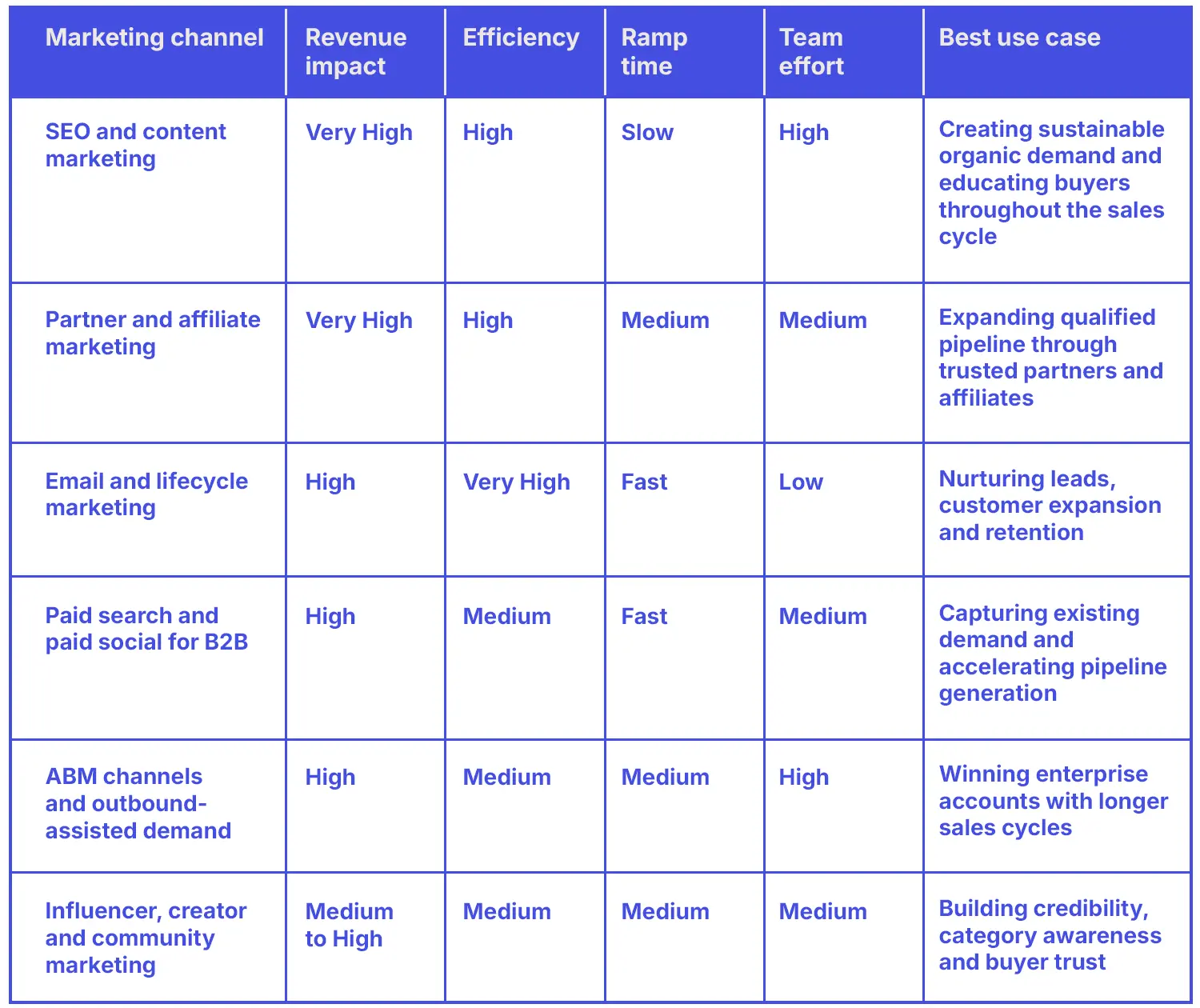
To compare the best B2B marketing channels, we evaluated each one across five criteria that influence revenue growth:
- Revenue impact: How consistently the channel generates qualified pipeline and closed-won revenue.
- Efficiency: The return relative to the investment required, including budget, resources and ongoing optimization.
- Team effort: The operational complexity needed to launch, manage and scale the channel.
- Ramp time: How quickly the channel starts producing measurable business results.
- Strategic fit: Where the channel delivers the greatest value based on factors such as average contract value (ACV), sales cycle and go-to-market maturity. (Note: In the comparison below, strategic fit is reflected in the “Best use case” column for each channel.)
The comparison below uses this framework to rank the best B2B marketing channels in 2026. It’ll help you balance short-term performance with long-term revenue growth.
The channels that matter most in 2026
Every channel in this ranking has earned its place based on how consistently it contributes to revenue. Here's where each one stands out and the situations where it delivers the greatest value.
SEO and content marketing
SEO and content marketing remain among the strongest revenue-generating marketing channels because they influence buyers throughout the research process. Comparison pages, product-led content, customer stories and educational resources continue attracting qualified prospects long after publication.
Strong content also supports visibility in AI-generated search experiences, which have become another source of discovery for B2B buyers.
Partner and affiliate marketing
Partner marketing channels and affiliate marketing continue climbing the list of the best B2B marketing channels because they help companies reach qualified buyers through trusted third parties. That momentum is reflected in recent partnerships data: according to PartnerStack’s The State of Partnerships in GTM 2026 report, 69 per cent of B2B SaaS companies plan to increase their investment in partnerships in the year ahead.
That shift reflects a broader change in B2B buying behavior, where buyers increasingly rely on recommendations from consultants, agencies, technology partners and industry experts before they engage with vendors.
You might also like: 7 B2B affiliate campaign ideas to run in 2026.
Email and lifecycle marketing
Email delivers value because it converts demand you've already created. Whether the goal is lead nurturing, customer onboarding or account expansion, lifecycle campaigns keep prospects and customers engaged throughout longer buying cycles. It also remains one of the lowest-cost channels to operate once the right automation is in place.
Paid search and paid social for B2B
Paid search and paid social for B2B give companies immediate visibility among buyers who already show purchase intent. They work well for product launches, competitive campaigns and new market expansion. The tradeoff is cost — performance depends on continued investment, and acquisition costs often increase as competition grows.
ABM channels and outbound-assisted demand
Account-based marketing (ABM) channels work best when marketing and sales focus on the same list of high-value accounts. Marketing creates awareness while sales delivers personalized outreach, making this approach well suited to enterprise deals with multiple stakeholders and longer sales cycles.
Influencer, creator and community marketing
B2B buyers increasingly rely on industry experts, LinkedIn creators and professional communities before speaking with vendors. These channels influence buying decisions long before prospects visit your website, making them a valuable complement to content, partnerships and paid acquisition.
You might also like: How B2B influencers fit into your partner program strategy.
Why partner channels are moving up the revenue stack
More B2B companies are relying on partner programs to grow a qualified pipeline. In fact, mid-market and enterprise B2B SaaS companies attribute an average of 35 per cent of new pipeline to partner-sourced or partner-influenced opportunities. That's one reason partnerships have become a much bigger part of modern go-to-market strategies.
For B2B companies, partner programs create value in two ways:
- Higher-quality demand: Partners introduce your product to audiences that closely match your ideal customer profile, which often leads to stronger conversion rates.
- More scalable distribution: Every new partner expands your reach without requiring a proportional increase in advertising spend.
Richardson notes that many companies still underestimate this contribution because attribution models don't capture it well. Teams often invest more heavily in bottom-funnel channels like paid search because they produce cleaner attribution reports, while partner programs receive less credit for creating demand earlier in the buying journey.
The gap becomes even more noticeable inside the CRM. Richardson explains that partner-sourced revenue often depends on a sales representative manually associating a partner with an opportunity, while paid media and other digital campaigns automatically record attribution through UTM parameters and campaign tracking.
“Partner-influenced revenue is even harder to capture,” she adds, “because influence is harder to define than source, and most CRMs don't have a clean native model for it.”

Where teams misallocate budget
The most common budgeting mistake isn't spending too much on one channel. It's allocating budget based on attribution reports that don't capture the full buyer journey.
Two patterns appear repeatedly across B2B companies:
- Overfunding channels that capture existing demand. Paid search and review sites generate clear attribution because they sit close to conversion. That visibility often earns them a larger share of marketing spend.
- Underfunding channels that create future demand. SEO, content and partner marketing channels influence buyers much earlier in the buying journey, but their contribution is harder to measure. Partner programs, in particular, tend to be seen “as a cost center or a nice-to-have rather than a pipeline engine,” Richardson says, “and because the degradation is slow and the attribution gap makes it hard to prove causality, the underinvestment compounds before anyone flags it.”
Over time, those decisions compound — budget shifts toward channels with the cleanest reporting while the channels that build awareness, trust and future pipeline receive less investment. As demand creation slows, revenue becomes harder to sustain.
How to build the right channel mix
The highest-performing B2B marketing channels aren't universal. A channel that drives strong revenue for a product-led SaaS company may deliver very different results for an enterprise business with a 12-month sales cycle. The best channel mix reflects how your customers evaluate, buy and adopt your product.
Match channels to ACV, sales cycle and market maturity
Use your buying motion to decide where each marketing dollar delivers the greatest impact.
- Lower ACV and shorter sales cycles: SEO and content marketing, paid search, email and affiliate marketing help capture existing demand and move buyers through the funnel faster.
- Higher ACV and enterprise sales: ABM channels, partner programs and educational content support longer buying journeys where multiple stakeholders influence the purchase decision.
- Earlier-stage companies: Paid acquisition can generate early visibility while SEO, partnerships and other B2B demand generation channels gain momentum.
- Established companies: A broader mix of organic content, partner programs and lifecycle marketing creates a more resilient pipeline and reduces dependence on paid acquisition over time.
The strongest channel mix balances immediate pipeline with future demand. Companies that invest across both short-term and compounding channels are better positioned to sustain growth as markets, competition and acquisition costs change.
Build a channel mix that drives sustainable revenue
No single channel drives sustainable revenue on its own. The strongest B2B teams invest across channels that generate demand, capture intent and support buyers throughout the entire journey.
The right mix depends on your market, sales motion and growth stage — but every channel should earn its budget based on its contribution to revenue.
If partnerships are part of your strategy, they deserve the same level of visibility as every other marketing channel. PartnerStack helps B2B SaaS companies recruit partners, manage partner programs and measure partner-sourced revenue alongside the rest of their marketing efforts, so you can make budget decisions with a complete view of what's driving growth.