What happens to your affiliate program when the seasonal campaigns end?
For most B2B teams, the answer is uncomfortable: partner activity drops, pipeline slows and revenue from affiliates flatlines until the next promotional window. But it doesn’t have to be this way.
The companies winning with affiliate programs in 2026 are building year-round systems that turn affiliate partners into consistent revenue drivers.
We spoke with Tye DeGrange, CEO and founder of RoundBarn Labs, who has over 20 years of experience in performance marketing and has built partner programs for brands like Google Workspace, Atlassian and Superhuman, to get an expert perspective on what works in B2B affiliate marketing.
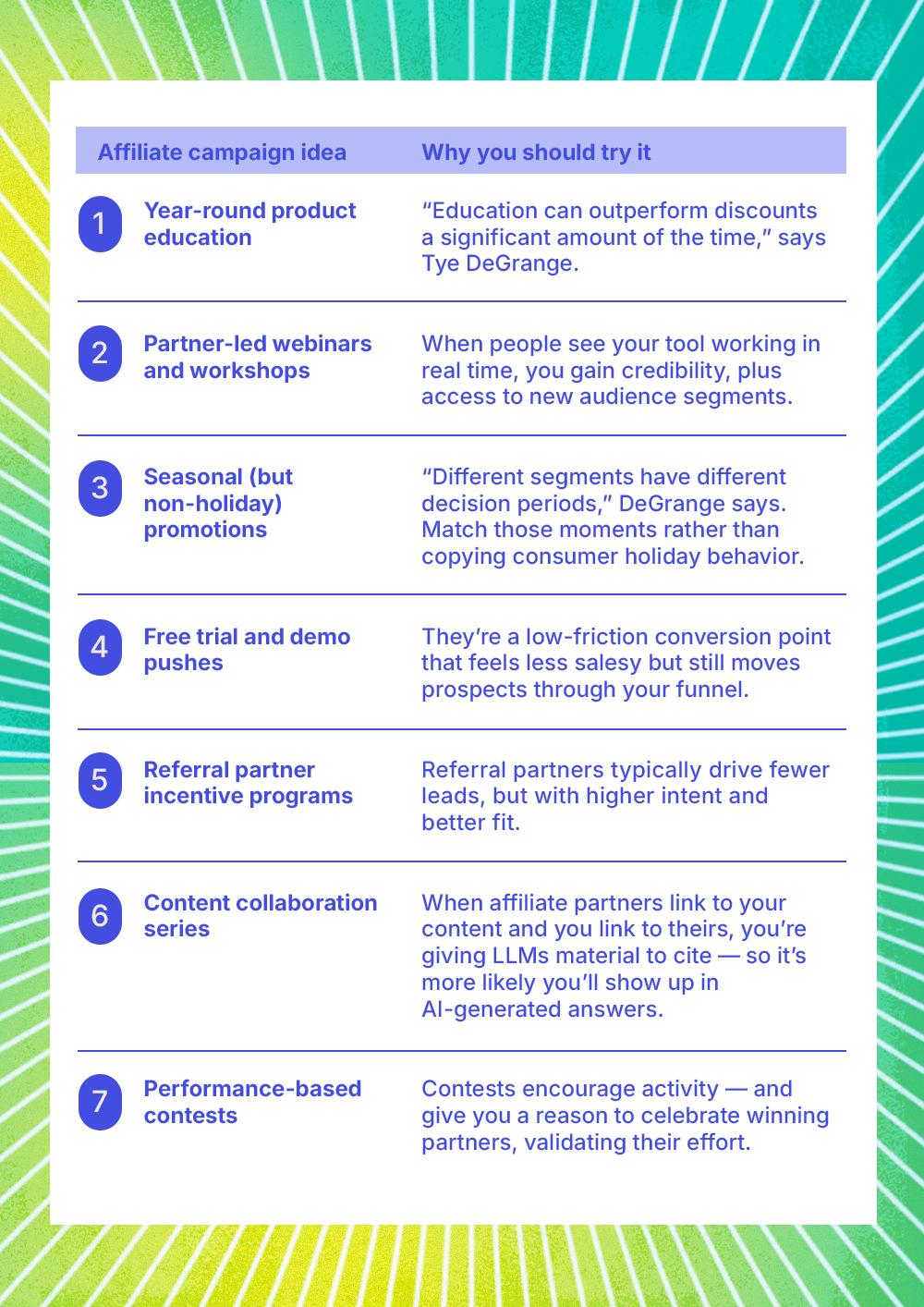
Here, he helps us break down seven B2B affiliate campaign ideas you can launch right now. These campaigns will help you keep qualified leads flowing and affiliate sales climbing through 2026 and beyond.
Why affiliate marketing remains crucial beyond Black Friday
B2B affiliate marketing doesn’t operate on the same cycle as consumer brands. Your buyers aren’t impulse shopping. They’re evaluating solutions over weeks or months, comparing features and getting buy-in from multiple stakeholders.
That means your affiliate marketing strategy can’t rely on flash sales and countdown timers. It needs to deliver consistent value that aligns with how B2B buyers actually make decisions. The best affiliate programs equip partners with educational materials, position affiliate links in evergreen content and create incentives that reward long-term relationships over quick conversions.
How ongoing campaigns sustain growth year-round
When you run ongoing affiliate campaigns, you’re building a reliable revenue stream that compounds over time.
“Year-round affiliate or partner efforts can outperform short-term promos because the space is relationship-based and long-term incentives matter,” DeGrange explains. “SaaS has long-term revenue and partners can be rewarded in perpetuity, which makes a long-term approach naturally fit.”
Your affiliate marketers become product experts who speak credibly about your solution. Your referral partners develop deeper relationships with their audiences. Finally, your affiliate network becomes a strategic asset that generates passive income for partners while driving predictable pipeline for you.
You might also like: 6 affiliate program tactics you need to win in 2026.
Campaign #1: Year-round product education
Too many affiliates treat every product the same way, relying on generic messaging that fails to connect with B2B buyers. This results in high traffic, low conversions and frustrated partnership teams.
DeGrange sees this regularly. “Education can outperform discounts a significant amount of the time because partners often do not have full context, levers or positioning,” he says. “Deeper conversations about ICP, pain points and value props help partners better educate their community.”
Provide affiliates with educational marketing materials
Create a content library that makes it easy for partners to learn and promote your product accurately. Include product walkthrough videos that demonstrate real use cases, customer success stories that provide social proof and competitive comparison guides that help affiliates position your solution against alternatives.
Host these materials in a centralized partner portal where affiliates can find what they need without waiting for email responses. Partner management platforms like PartnerStack centralize all resources, so partners consistently access current materials without hunting through email threads or outdated folders.
Scale with webinars, training videos and guides
Schedule regular webinars where your product team walks through new features, answers questions and shares best practices. Record these sessions and add them to your resource library so new partners can catch up asynchronously.
DeGrange points out that most teams can’t sustain individual training for every partner: “It is hard to do one-to-one at scale, so it needs one-to-many education, but top partners can be supported more directly.”
Campaign #2: Partner-led webinars and workshops
When you co-host a session and the partner walks through the product, people see the tool working in real time. You gain credibility by association and access to a new audience segment.
Identify your best affiliate marketers and suggest joint webinar topics that align with their expertise and your product capabilities. Find overlap where both parties bring unique value. Keep the promotion collaborative — both parties should drive registrations through their channels, multiplying reach and signaling that the content is valuable.
Record every session and repurpose the content. For example, you can turn key moments into social clips or extract quotes for blog posts. You can also create a resource library of past webinars for new partners to leverage.
See also: AI is changing affiliate marketing — here’s how leaders are adapting.
Campaign #3: Seasonal (but non-holiday) promotions
Meet buyers where they already are — when they’re actively searching, have budget approved or are feeling specific pain points most acutely.
Unlike consumer holidays where everyone competes for the same attention, B2B seasonal moments are fragmented across different industries, roles and business cycles. For SaaS companies selling to marketing teams, that might be major conferences like INBOUND or MarTech. For financial services software, it’s tax season and quarter-end closing periods.
Identify these high-intent moments for your specific buyers, then arm your partners with the right positioning and materials to capitalize on them.
Map your buyer’s seasonal calendar
Start by identifying when your target buyers are most likely evaluating, purchasing or experiencing pain that your solution solves:
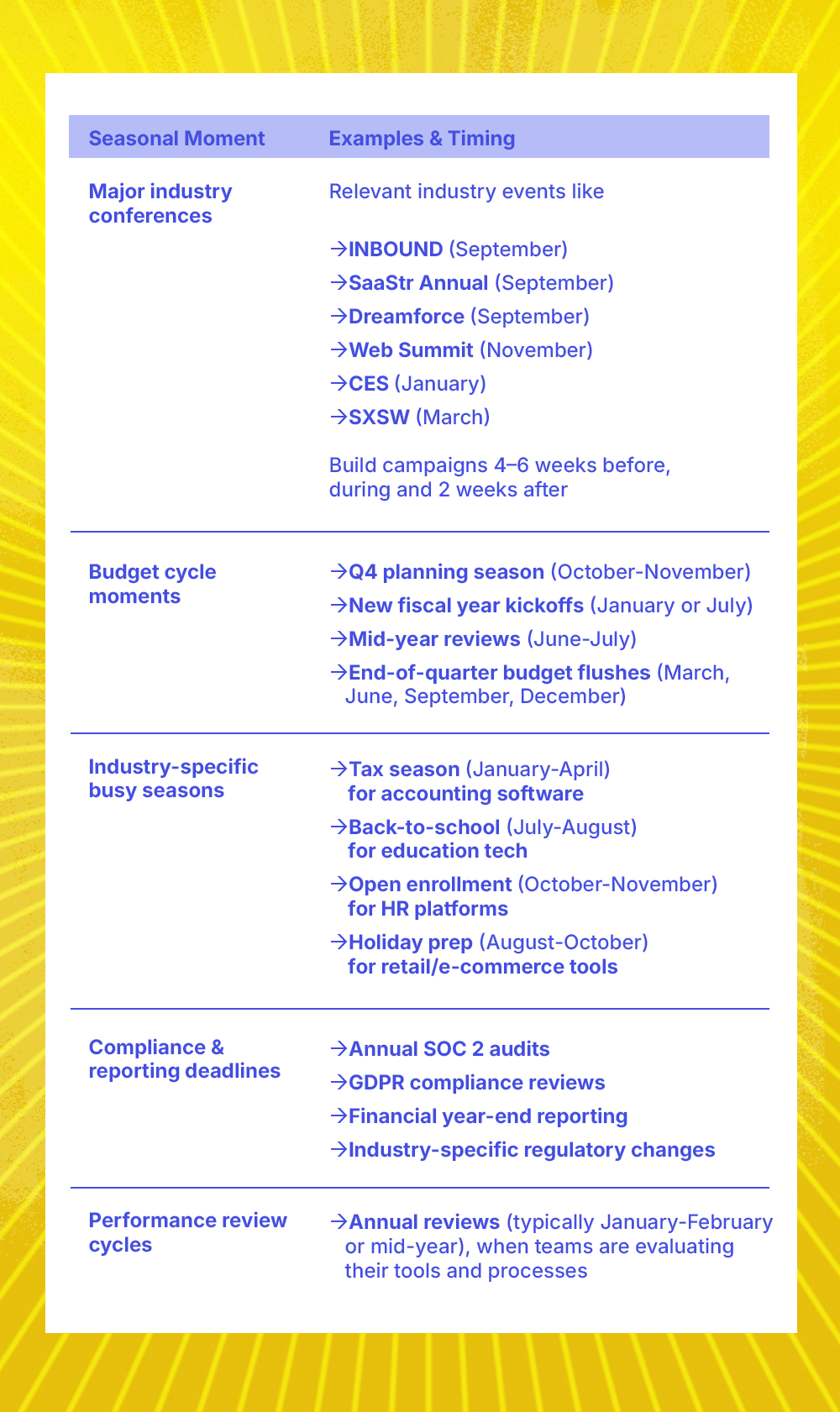
“Anchor to communities of interest, ICP and buyer calendars,” DeGrange says. “Different segments have different conference cycles, budgeting timelines and decision periods. Campaigns should match those moments rather than copying consumer holiday behavior.”
Campaign #4: Free trial and demo pushes
Free trial and demo campaigns give affiliate partners a low-friction conversion point that feels less salesy while still moving prospects through your funnel.
Your affiliate program should reward trial signups and demo bookings, not just closed deals. This encourages affiliates to drive top-of-funnel activity while your sales team handles conversion. When partners can see exactly how their traffic converts, they can optimize their approach and feel confident they’re being compensated fairly.
Provide real-time visibility into clicks on affiliate links, trial signups attributed to each partner, demo bookings and conversion rates, and closed deals with commission earned.
DeGrange emphasizes that quality tracking is often overlooked. “Regularly evaluating lead quality by cohort and quarter is often underutilized,” he notes. “Teams assume quality stays the same. There should be thoughtful analysis and expectation setting with partners that quality will be evaluated.”
Set clear boundaries around what constitutes a qualified lead. Balance these quality requirements with upside incentives like bonuses for partners who deliver both volume and quality.
Campaign #5: Referral partner incentive programs
Referral partners — complementary service providers, consultants or existing customers with direct relationships to your target buyers — typically drive fewer leads, but ones with higher intent and better fit.
Create tiered commission structures that increase with performance. Start with a base rate that’s competitive with the best affiliate programs in your space. Add bonuses for referrals that close within certain timeframes or exceed specific deal sizes.
DeGrange recommends a balanced approach. “Incentivize across a spectrum of valuable actions, but do not reward every micro action. Value each action differently and avoid overpaying for low-value activities,” he says. “Different partner types may need different structures or focus metrics.”
He describes a quarterly lift campaign where teams forecast expected performance with a subset of partners and agree on clear targets ahead of time. Partners commit to additional effort, such as creating new content, building landing pages or running paid media. In return, they earn higher commissions or bonus incentives when they outperform the forecast.
Without automated systems, maintaining this transparency requires someone on your team to pull reports and manually update partners. Partner management platforms like PartnerStack handle commission calculations and reporting automatically, so partners see their performance and earnings in real time.

Campaign #6: Content collaboration series
Content collaboration transforms affiliate partners from external promoters into integrated extensions of your marketing team.
Start by identifying content opportunities that serve both audiences. What topics sit at the intersection of your expertise and that of your partner? Where can you combine perspectives or data to create something neither party could produce alone?
Whitepapers and research reports work particularly well. Partner with affiliates to survey your combined audiences, analyze the results and publish findings that benefit the broader industry. Co-authored blog posts allow you to tap into the partner's audience while providing them with quality content. These collaborations naturally incorporate affiliate links while delivering genuine value.
Build AEO and SEO visibility through shared content
When affiliate partners link to your content and you link to theirs, you’re building domain authority and referral traffic simultaneously — plus giving AI-powered answer engines important context and material. These collaborative efforts expand your content footprint.
Track performance metrics for each collaborative piece. Which topics drive the most traffic? What CTAs convert best? Which partners have audiences that align most closely with your target buyers? Use these insights to refine future collaborations.
Read more: AEO for partnerships: how to rank in answer engines.
Campaign #7: Performance-based contests
Contests that recognize and reward top-performing partners tap into fundamental human psychology while accelerating program growth.
Design contests that feel achievable for a range of partners while still pushing top performers to new heights. Contests that reward only the highest performer can demotivate the majority of participants.
Structure contests around specific campaign periods or goals. Maybe you’re launching a new product feature and want maximum visibility. Or pushing into a new market segment and need partners focused on that audience.
Create multiple winner categories, such as highest revenue generator, most improved performance, highest conversion rate or best creative use of marketing materials.
Time-bound contests create urgency. A 30-day sprint focused on trial signups, or a quarterly competition for the most deals closed, gives partners a clear target and deadline.
Publicly recognize top affiliates
When you publicly celebrate winning partners, you’re validating their effort and signaling to others that success in your program is both possible and rewarding.
Ways to recognize winners:
- Spotlight them on your blog and social media channels
- Feature them in your newsletter to your entire partner ecosystem
- Invite them to speak at partner events or on company webinars
- Give them early access to new features or beta programs
This public recognition serves multiple purposes. It rewards winners with visibility and credibility they can leverage with their own audiences. It shows other partners what success in your program looks like. And it strengthens relationships with top performers, making them more likely to continue prioritizing your product.
DeGrange emphasizes that consistent activity is a key health indicator. “Many programs have low consistent activity rates, sometimes close to 25%, which signals a lot of cleanup is needed.” Performance contests help move that needle.
Drive year-round growth with strategic affiliate campaigns
The most successful affiliate programs layer multiple approaches, creating a diverse mix that engages different partner types and reaches buyers at various stages of the decision process.
Most companies hit a ceiling around 20 to 30 active partners when managing programs manually. PartnerStack handles partner onboarding, performance tracking, automated payouts and reporting — removing the bottlenecks that prevent programs from scaling. Book a demo here.