For decades, we’ve been talking to the internet. Now, the internet is talking back.
For B2B SaaS companies, this is a big change. Enterprise buyers aren’t just typing “best CDP” into Google anymore. They’re also typing something like this into ChatGPT:
“We have Salesforce, Klaviyo and GA4. Our goals are to drive 10% higher LTV over the next year, expand mid-market accounts and build a legit multi-touch attribution model. What’s a customer data platform for our stack that will help us hit our OKRs? It needs to be SOC 2 compliant.”
If you’re not in the results, the truth is, you’re probably out of the running.
Chances are, your marketing team is already racing to optimize your content for LLMs. But there may be an even faster way to dominate AI search: through your partner ecosystem.
To understand more about what answer engine optimization (AEO) means for B2B partnerships and how to turn your partner program into a ranking advantage, we sat down with Nick Lafferty at Profound and Steve Toth at AI Notebook and Notebook Agency.
Before we get into tactics, let’s quickly define what AEO is.
What Is Answer Engine Optimization (AEO)?
Answer engine optimization (AEO) is the process of making your brand visible in AI-generated answers — whether that’s in ChatGPT, Perplexity, Gemini or Google AI overviews. When you ask one of these platforms a question, it:
- Interprets your query.
- Tries to find the answer across sources it trusts, like websites, marketplaces, directories, forums and publicly available help docs.
- Synthesizes information from multiple sources (and any context it knows about you from previous searches) into a coherent answer.
So, unlike traditional SEO, which focuses on ranking for specific keywords, “AEO is more about how to support the reasoning journey of an AI with your content, and getting your brand cited and recommended in those answers,” Toth explains.
How AEO Impacts B2B Partnerships
When partners, affiliates, industry publications and third-party review sites mention your brand and reinforce your key differentiators, they’re teaching AI to associate your brand with specific use cases, industries, job titles and problems prospects are trying to solve — particularly when those mentions come from sources that carry authority and trust.
The more clearly your product gets described in credible contexts, the more likely AI is to recommend it over a competitor.
Read more: Navigating SEO in 2026: Implications for B2B partnership content strategies.
How to Optimize Your Partner Ecosystem for AI Search
The B2B brands winning in answer engines are sending a consistent message across their entire ecosystem. Here are seven strategies to help you do the same:
1. Refine your marketplace and app directory profiles
AI models prioritize marketplaces and directories because they aggregate vetted information in one place. They often have:
- Comparative data (pricing for this platform vs. that one)
- Reviews from real users
- Standardized formatting that makes it easy for AI to extract and synthesize answers quickly
Plus, established marketplaces carry built-in authority that newer or individual vendor sites may lack.
Action steps
Treat your profile like the answer to buyers’ search prompts. What do they want to know, and how fast can they find it? Make it easier for AI (and humans) to find you by:
- Using language that mirrors how people actually ask questions. Instead of describing your product as an “enterprise-grade collaboration solution,” try “best tool for remote teams managing complex projects across multiple time zones.”
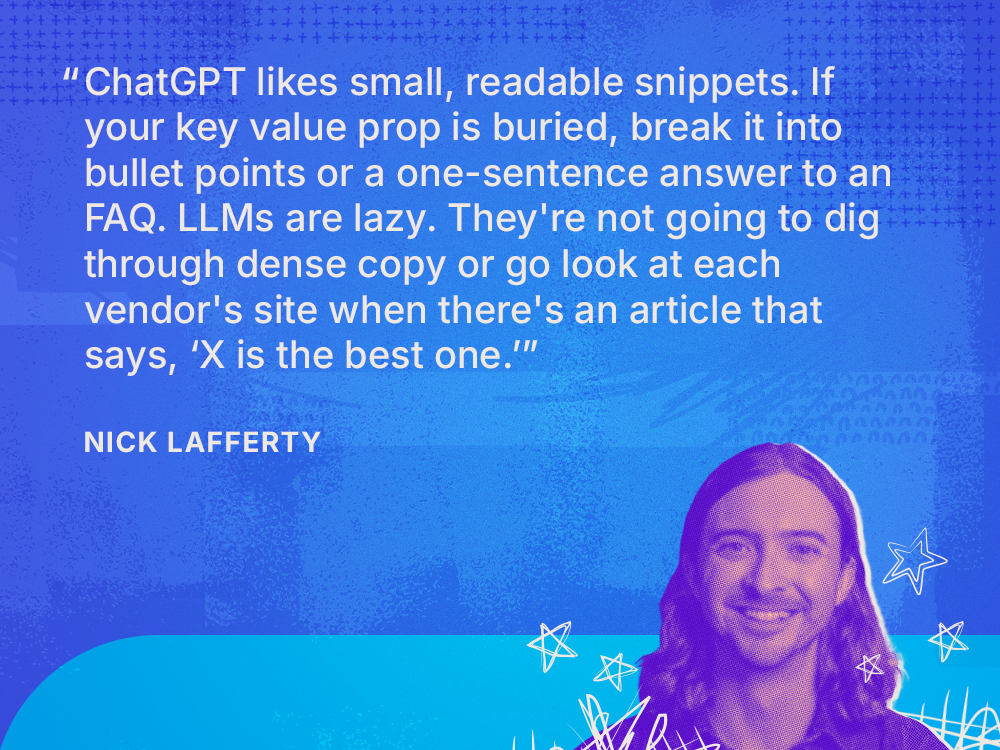
- Keeping your profile tight and scannable. “ChatGPT likes small, readable snippets, around 100 characters,” Lafferty points out. “If your key value prop is buried in the fourth paragraph, break it into bullet points or a one or two-sentence answer to an FAQ. LLMs are lazy. They’re not going to dig through dense copy or go look at each vendor’s site when there’s an article or FAQ that says, ‘X is the best one.’”
- Describing clear entity relationships between your brand, industry, products, use cases, and integrations or partners within your profiles. For example, “Acme Analytics [brand] helps fintech companies [industry] analyze customer churn [use case] through our dashboard product [product] that integrates with Stripe and Plaid [partners].”
2. Talk about your “deal breakers” everywhere
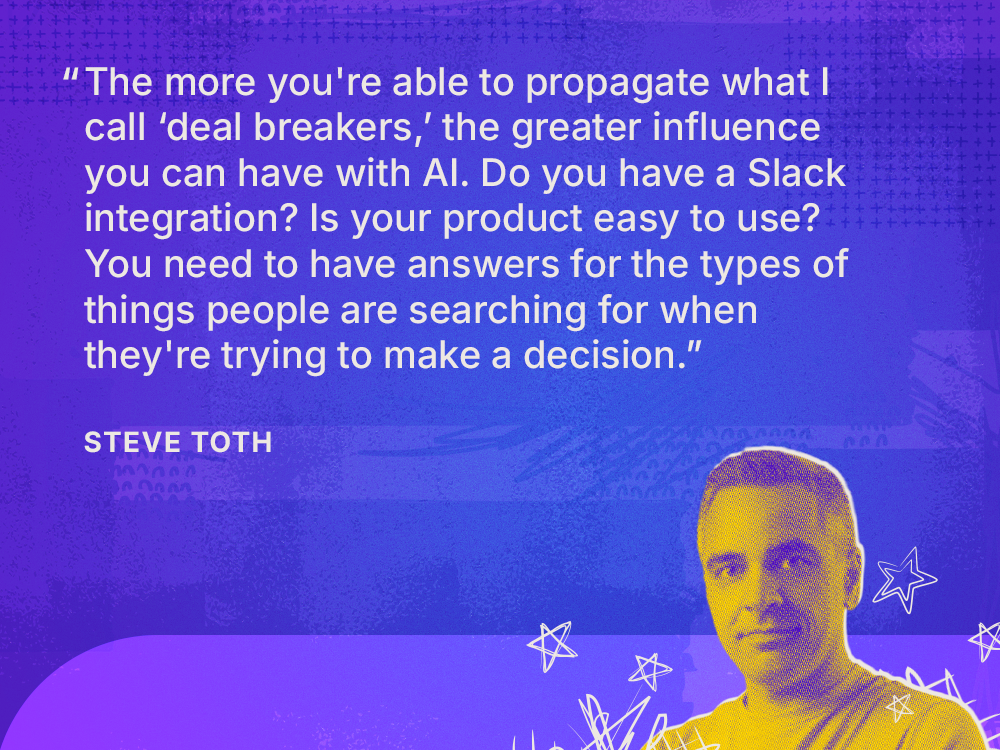
Your key differentiators need to be everywhere AI models look. “The more you’re able to propagate what I call ‘deal breakers,’ the greater influence you can have with AI to know certain things about you,” Toth emphasizes.
“Are you GDPR compliant? Do you have a Slack integration? Is your product easy to use? Do you have customer support in AEST? You need to have answers for the types of things people are searching for in AI engines when they’re trying to make a decision.”
Action step
These deal breakers should already be in your partner enablement materials, but make sure they also appear in your:
- Marketplace and directory profiles
- Integration page copy
- Joint case studies and testimonials
- Co-branded comparison pages (more on that later)
- Wikipedia page and other third-party sites, like G2 or Reddit (though LLMs are constantly changing their algorithm, so prioritize your own first-party data)
3. Double down on listicles
If you think you’ve been seeing more “top 10 [insert type] software” articles getting published, you’re right. Many publishers and creators in the PartnerStack Network are also leaning in to support B2B SaaS vendors through producing this type of partnership content.
“Listicles conveniently rank highly in Google and in answer engines,” Lafferty reports. “At Profound, we see that earned media, like affiliate publishers, sometimes have up to 90 per cent of the total citations.”
While it’s not a direct parallel to B2B, he points to his own research in the online mattress space as proof of how critical affiliate links are:
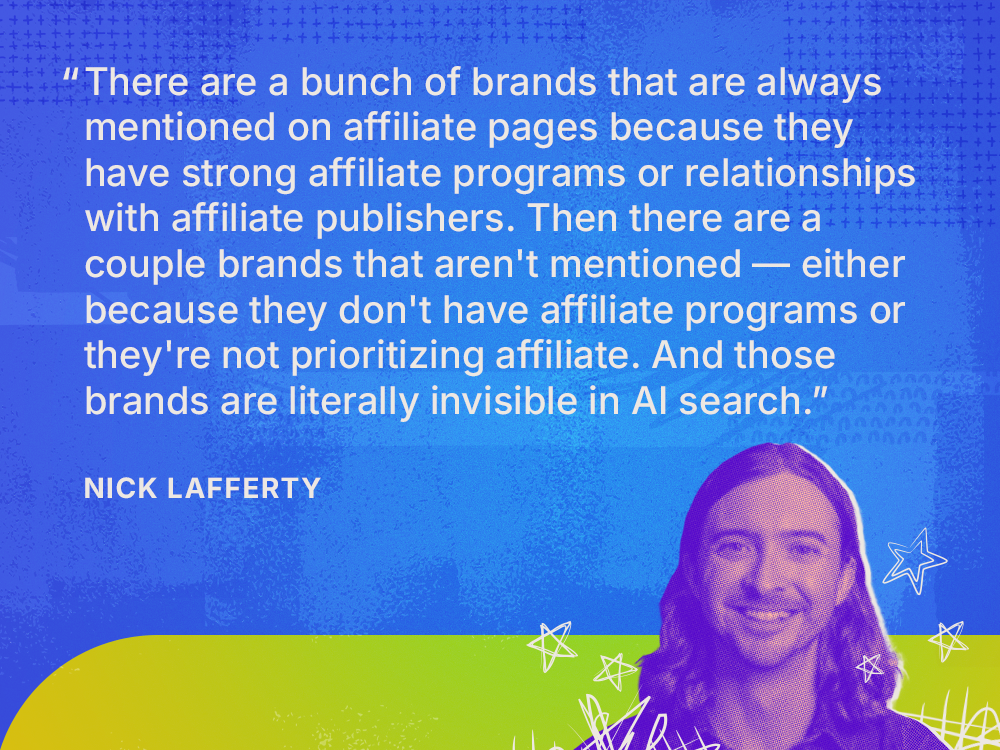
“There are a bunch of brands that are always mentioned on affiliate pages because they have strong affiliate programs or relationships with affiliate publishers. Then there are a couple of brands that aren’t mentioned — either because they don’t have affiliate programs or they’re not prioritizing affiliate. And those brands are literally invisible in AI search.”
Action step(s)
If you already have high domain authority/are a popular affiliate publisher:
Your goals should be two-fold: (1) keep publishing listicles to maintain your authority, and (2) figure out how to monetize them.
“Affiliate publishers are very well positioned to say, ‘Hey, if I list you in my listicle, I can almost guarantee that you show up in ChatGPT. And if you’re not in my listicle, you won’t show up in ChatGPT,’” Lafferty says. “They can become kind of the gatekeeper of deciding if brands show up or not.”
See also: AI is reshaping affiliate marketing — here’s how leaders are adapting.
If you do not have high domain authority/are not a popular affiliate publisher:
Get into as many partner roundup articles as possible. “Roundups associate your brand with other brands that you want to be associated with,” Toth says. “If you’re an up-and-coming project management system, you want your brand to be in the same space as the ClickUps and Monday.coms of the world.”
If you’re not showing up among your peers, Toth warns, “LLMs won’t have your brand baked into their next model update as being semantically close to those other brands.”
4. Make different versions of your content for each ICP
When you type a question into ChatGPT, you’re going to get a different answer than your coworker, friend or mom. That’s because all of you have been using ChatGPT for different purposes — and, in that process, the engine has learned a lot about you and your preferences.
“When an individual user does a search, that information is passed on to the generative engine, which compiles the results and personalizes them to the user at a granular level,” Toth explains. “Think about ChatGPT Deep Research: it explicitly asks you what company you work for, where you typically search for software and what, exactly, you’re looking for.”
For B2B SaaS companies, this “user embedding” process means personalized content will only become even more crucial, and it’s already playing out in the B2B buying cycle.
“If I search for project management software, it’s going to give me results skewed toward an agency owner, like ClickUp or Monday.com. If a developer uses the same prompt, she’ll see Jira,” Toth says.
Action step
Consider creating several versions of your best-performing content — one for each slice of your ICP. Start by reviewing your portal library analytics to see what partners downloaded the most last year. Then:
- Work with your partner marketing team to revise them for each segment.
- Publish them, ungated, on your website.
- Work with your partner enablement team to ensure each partner sees the most relevant content in your portal (for example, solution partners may cater to a different segment of your ICP than an affiliate) and to explain how they can best use these assets.
5. Publish battle cards outside of your partner library
Answer engines eat comparison pages up because they save time. Models don’t have to crawl disparate sites to find information if you’re serving it up for them. And the more specific you can be about what your product is and who it’s for, the better.
“You want to niche down your comparison pages to different ICPs,” Toth recommends. “For example, ‘FreshBooks versus QuickBooks for graphic designers,’ or ‘QuickBooks alternatives for graphic designers’ or even ‘best invoice software for graphic designers.’ You’re helping the LLM with user embedding, and you provide a content format that the LLM can easily parse and cite.”
You could even create separate pricing pages for each ICP. If your pricing is bespoke, you can at least provide a rough idea of what it might cost based on certain parameters — and highlight the value props each part of your ICP would care most about, like your product’s ability to support specific use cases or integrations, or the caliber of your support team.
Action step
Work some of your distinguishing factors into your marketplace pages and listicles. You’re probably already doing this, but maybe not as explicitly as you could be. If there’s a way (within the word limit) to share which features map best to each ICP (e.g., ‘mid-market customers benefit most from X’) or quotes from customers in each ICP segment — do it.
You might also like: Partner enablement tips to drive revenue and strengthen your ecosystem.
6. Put more thought leadership on LinkedIn
In the fall of 2025, LinkedIn started sharing user data with Microsoft and its affiliates for AI training. That means LinkedIn is prime real estate for shaping how LLMs understand your company and your partnerships.
Action step
Make sure you’ve got a consistent message about what your company does, who it partners with and the value it provides — all over LinkedIn. That involves:
- Describing your company accurately on your company page, including major partners you want to be associated with
- Asking employees to use a specific blurb about your company on their profiles
- Asking partners to use sample copy when they’re talking about your company on LinkedIn
- Posting and cross-posting partner-related information, especially as it pertains to Toth’s ‘deal breakers’
There’s one more sneaky way to share co-marketing content: LinkedIn Pulse. “LinkedIn Pulse shows up a fair amount in LLM searches,” Lafferty says. “If you go write a couple of those, there’s a good chance they’ll start to be picked up, and it’s super low-hanging fruit if you were going to publish anyway.”
Bonus tip: Lafferty says that Gemini and Google AI overviews tend to overindex on YouTube as a citation source. So, if you know your and your partners’ target personas tend to use Google more often, try creating more joint YouTube videos.
7. Write a solid research report
Turning a large-scale survey into a research report is a fantastic way to build your authority. If other news outlets, industry publications or widely-read online newsletters pick up a stat or two, you’re instantly getting more press — and increasing your chances of showing up in LLM results.
Action step
Use your research report as a partner visibility play. Giving them more visibility is good for your relationship and for brand association. Try to weave in partner perspectives where you can through expert quotes, links to integration pages or joint case studies.
But resist the urge to gate it.
“If you have to for lead gen purposes, dump all the text into a blog post,” Toth suggests. “It’ll be the world’s longest article, but that’s one of the only ways to make sure it gets pulled into the index.”

Tracking and Measuring AEO Success
Tracking AEO is a little tricky, just because of the personalization element (you’ll get different results for the same prompt than a coworker will). But it’s not impossible. Here are some KPIs you’ll want to keep track of:
General visibility
- How often is your brand mentioned in AI answers? Track 5-10 core prompts weekly in a spreadsheet. If you’re still small, just aim to be mentioned. If you’re a big brand, target a lot higher (90%+) citation rates.
- What percentage of your AI citations come from partner content versus owned channels? If 60%+ of citations pull from partner sites, your ecosystem strategy is working quite well. If it’s mostly your own content, you’ve got a growth opportunity on your hands.
- Are your integration pages and marketplace listings appearing in AI answers when users ask about your partners’ ecosystems? If not, take some time to refine your listing based on your deal breakers. If that doesn’t help, maybe it’s time to reevaluate what value props truly resonate with your ICP.
Quality of results
- Are you being cited alongside the partners you want to be associated with? If not, you risk seeming like an outlier or tool that’s not ready to accommodate mid-market or enterprise customers.
- Are the answers in line with a sales-grade answer? Compare what AI says about you to your approved messaging.
- Are you cited positively, negatively or neutrally? Being cited for “affordable but limited features” hits differently than “best value for small teams.”
Traffic
- What is your overall AI bot citation traffic? This acts as a proxy for how many people are searching for topics in your space. Note: You’ll need to use a tool that hooks up to your hosting provider to figure this out.
- Is traffic from partner domains increasing as you optimize for AEO? Rising partner referral traffic could suggest your co-marketing content is both ranking in traditional search and AEO.
The Future of AEO for Partnerships
Today, the goal is to optimize for human-led AI search. But in five years or so, the most valuable visitors to your website may not even be people. Soon, you’ll be competing for the attention of AI agents who scan the web and make decisions on a buyer’s behalf.
AEO is how you prepare for that reality. Getting your brand cited and recommended now will give you more control over your visibility, credibility (and ultimately, your pipeline) later. But most partner teams don’t quite know where to start.
PartnerStack helps you identify high-intent questions, benchmark your share of voice against competitors and activate the right partners to scale your citations.
Want to see where your brand stands? Get a free AEO audit.