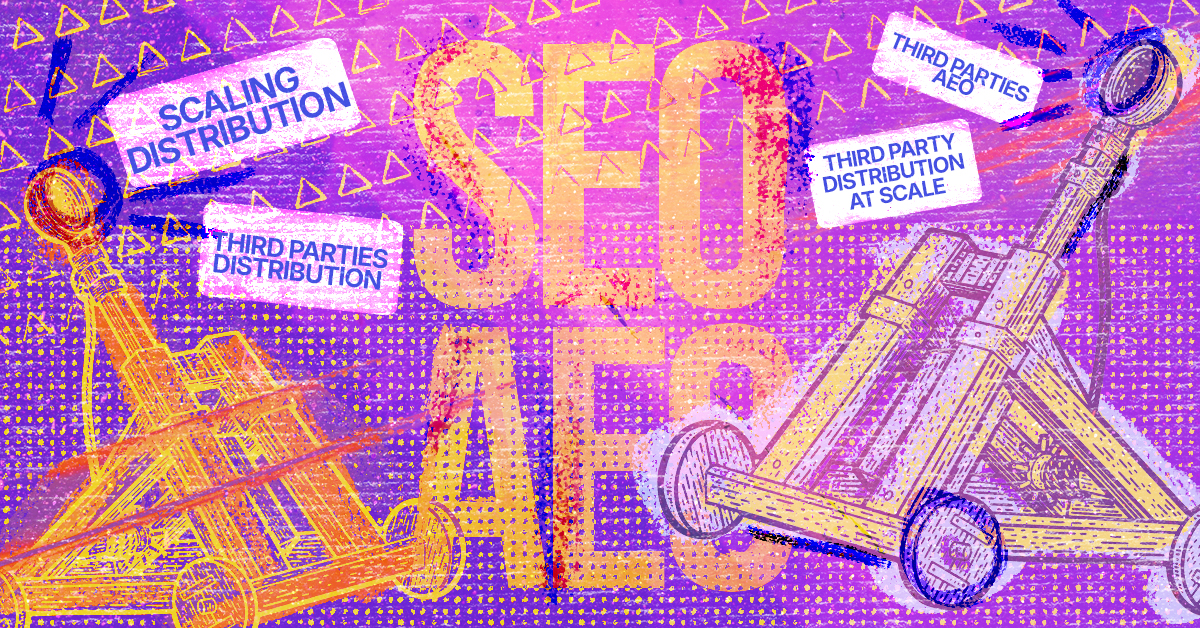
AEO/GEO is early SEO, compressed. The arbitrage window is open, then platforms harden, then authority consolidates.
There’s lots of buzz around getting brands cited. But if we build an AEO business around “getting brands cited,” we’ll catch a wave — and then wipe out when models evolve their algos in a way that isn’t friendly to the tactics we’ve enabled at scale.
If, however, we build around first principles, such as credible third-party distribution at scale, we become durable infrastructure. That means we have governance, quality, diversification and proof tied to revenue outcomes, not visibility vanity metrics.
At this stage of AEO, the key question for every bet is, “Does this get stronger when the algorithm gets smarter?”
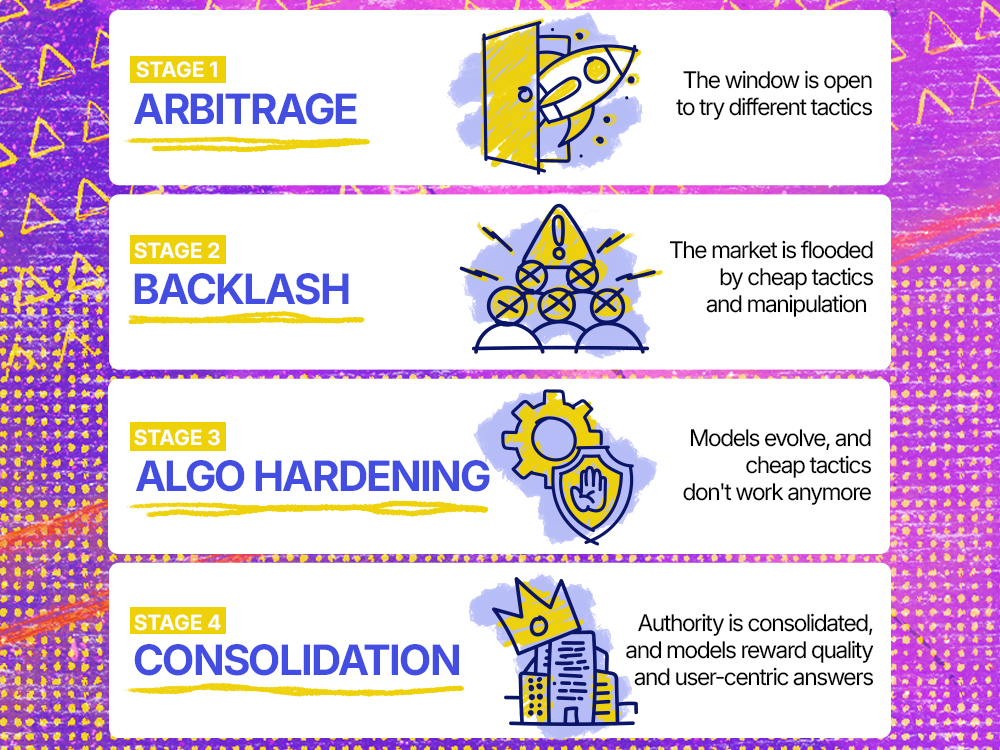
How AEO repeats the same development cycle as SEO
SEO moved in a cycle with four stages:
1. Arbitrage
2. Backlash
3. Algo Hardening
4. Consolidation
And this cycle is already visible in AEO. What’s more, the cycle will move faster than it did with SEO because LLM pipelines are always on. When PartnerStack released its Women in SaaS 2026 Report last week, for example, it showed up in answer engines the same day.
So, when we’re thinking about AEO, we should assume that:
- Cheap tactics will decay fast.
- Manipulation will get discounted or penalized.
- “Affiliate-only” content can become a trust liability if it looks coordinated or overly synthetic.
Right now, we also see that the surviving “SEO truths” map cleanly to AEO:
- Topical authority
- Trustworthy entity signals
- User-centric answers
Let’s take a closer look at some of the risks we run when trying to build a durable AEO advantage.
Risk 1: We accidentally become the link-farm era of AEO
Failure looks like:
- We incentivize volume over credibility.
- We over-coordinate messaging.
- We let low-quality affiliates flood the ecosystem.
- We only solve for visibility via affiliate content.
An entire industry was built to undo bad SEO for almost a decade, where agencies would go out and get bad content removed so it wouldn’t continue to hurt the brand.
What happens if we flood the market with affiliate content, only for the LLMs to not only decide they won’t look at it, but they also decide that any brands that are heavily skewed toward affiliate content will be penalized?
Result:
Models discount anything that looks like a pattern of coordination, repetition or thin utility.
How we avoid this kind of failure:
- Build a Network Credibility Standard, which could specify publisher/creator tiers, editorial requirements, disclosure requirements and an update cadence.
- Reward originality and verification (think benchmarks, data, frameworks) because that’s what gets cited academically.
- Treat “embarrassed in front of the model developer” as a hard internal test for anything that looks like gaming.
Read more: AEO for partnerships: how to rank in answer engines.
Risk 2: Measurement gets opaque and the budget dies
Failure looks like:
- We over-index on visibility metrics.
- Citations become less transparent.
- We can’t connect work to pipeline and revenue.
Result:
Measuring impact becomes meaningless — or impossible — so we can’t justify the effort.
How we avoid this kind of failure:
- Productize an incrementality story, in which exposure → engagement → influenced pipeline → deal velocity, with controls where possible.

Risk 3: Platforms harden against overt influence and manipulation
Failure looks like:
- We build a business dependent on current model quirks.
- We sell deterministic outcomes in a probabilistic system.
Result:
Our business becomes obsolete as soon as the model changes and quirks disappear.
How we avoid this kind of failure:
- Non-negotiables stay non-negotiable: no guarantees, no synthetic spam, no prompt gimmicks as the core.
- Design the motion so algorithm shifts make us stronger.
You might also like: AEO for partnerships: How to shift content strategy to rank in LLMs.
Risk 4: Commoditization via dashboards and scores
Failure looks like:
- We compete like SEO tooling, with feature parity and margin compression.
Result:
We end up with dashboards that provide a score, but little substance beyond that.
How we avoid this kind of failure:
- We make the network, relationships and performance model our moat — not a dashboard that’s already been commoditized.
- Tooling supports the system, with distribution, governance and outcomes providing defensibility.
See also: Navigating SEO in 2026: implications for B2B partnership content strategies.
Risk 5: We ignore conversation surfaces and over-fixate on pages
Failure looks like:
- We treat AEO like classic SEO.
- We underinvest in communities where models increasingly learn from live discussion.
Result:
We’re stuck on pages while the conversation — and models — have already moved on.
How we avoid this kind of failure:
- Build a community participation motion, prioritizing getting experts in the right threads and making authentic contributions.

The crawl, walk and run stages of AEO
I expect AEO to go through three stages:
1. Crawl: Prove ability.
2. Walk: Systematize credibility.
3. Run: Become infrastructure.
The crawl stage will include unstable tactics. That’s fine. What matters is that we architect it so we can shed the unstable layer without breaking the business.
The real mistakes would be:
- Building revenue dependent on model quirks.
- Over-indexing on citation volume.
- Hard-wiring rank promises into contracts.
If we can avoid those, we can build durable advantage as AEO matures.