Every partner program starts somewhere. Even the companies running multi-channel ecosystems today were once managing a handful of partners on a spreadsheet.
The difference between programs that stall and programs that scale is knowing which stage you’re in. Without a shared maturity framework, partnership leaders sometimes struggle to mark success, benchmark progress, communicate value to their executive team or make a clear case for what their partner ecosystem needs next.
According to PartnerStack’s State of Partnerships in GTM 2026 report, 69 per cent of companies plan to increase their investment in partnerships — but without a framework, that investment risks going to the wrong places.
To build that framework, we spoke with three PartnerStack customer success managers and studied the partner programs of real companies at every stage of growth. The result? Four stages of partnership maturity: exploring, scaling, building and optimizing.
In this article, we’ll break down:
- What each stage looks like in practice, benchmarked against real partner programs that drive revenue through these indirect channels
- The GTM motions, KPIs and team structures that define each level
- How to know when you're ready to move from one stage to the next

Stage 1: Exploring
The exploring stage is where most partner programs begin. Companies here are actively figuring out what works. The team is small, say one or two people, often managing partnerships alongside other responsibilities, and the tools are minimal.
SaaS companies like Campaign Monitor can provide a strong example of what this looks like. The email marketing platform has a single affiliate partner, Level Up Ventures, a business coaching company that recommends Campaign Monitor to student cohorts. Those students sign up and convert to paid. Other partners drive clicks and signups, but aren’t converting.
“They have one big success story right now, and they’re like, are there more of these people? Or did we just get lucky?” says Adam Faber, Senior Customer Success Manager at PartnerStack.
Bitdefender, a well-known cybersecurity brand, is in a similar position. Its partnership program is currently managed by a single external resource as the company works to identify the right partners for its ecosystem.
KPIs at the Exploring stage
- Clicks and signups: These are the earliest proof points that partner activity is generating interest. “Clicks and signups are the promise. The dollars are the meat and potatoes,” Faber says.
- Partner onboarding time: How quickly new partners become active.
- First deals sourced: Early proof of the channel’s growth potential.
GTM motions at the Exploring stage
- Reactive deal flow: Deals occur opportunistically rather than through a documented process.
- Broad recruitment: A wide net to learn which partner profiles perform.
How to move beyond exploring
Partnerships evolve, which means no single playbook works for every motion. Once you can describe what makes your successful partner work, build a persona based on that, and start recruiting lookalikes. The shift from “we got lucky” to “we know what works” is what separates exploring from the next stage.
You might also like: What great partner onboarding looks like (with examples).

Stage 2: Scaling
Programs in the Scaling stage have moved beyond experimenting to replicating what works. The team is growing, and the technology stack has evolved to a PRM with tracking, dashboards and attribution.
This is where partnership strategy becomes data-driven and strategic partnerships start to form around proven partner profiles — and partner programs have formed their IPPs.
Sunsama is a clear benchmark. The daily planner platform has around a thousand partners. About a hundred are driving paid customers. The top three have each brought in roughly 140, and by the 100th partner, the numbers drop to one or two.
“Your top 10 or 20% of your partners are going to drive 80% of your revenue,” Faber says. He adds that “they’re now figuring out who to focus on and who to ignore.” This is what maturing from the exploring stage affords you.
Practice Better, a SaaS company that helps health and wellness practitioners manage their practices, is a good example of what deliberate scaling looks like. “They have identified their best partner fit and have done significant work to grow it,” says Emily McKeown, Customer Success Manager at PartnerStack. “Their team is four-plus people, and they have a dedicated team that solely manages customer referrals, which works really well.”
That kind of investment in a dedicated referral team signals an organization that has moved past exploration and is systematically scaling what works.
KPIs at the Scaling stage
- Active partner count: How many are producing revenue, not how many signed up. Network-approved partners are 14x more likely to generate revenue.
- Partner-sourced revenue: Referrals may be 10% of the pipeline, but account for 31% of revenue.
- Partner quality: As revenue grows, so does the risk of bad traffic. “If someone is driving bad traffic that you’re paying for, it’s going to be a difficult conversation with your boss,” Faber warns.
GTM motions at the Scaling stage
- Outbound recruitment using success stories: Once you have partners producing results, they become your best recruiting tool. Instead of cold outreach, you lead with proof.
- Breaking the referral ceiling: “A customer is going to know one or two people. And that’s it,” says Gina Gillis, Customer Success Manager at PartnerStack. The move to affiliate or ambassador motions is classic at this stage.
- Partner enablement at scale: Documenting what top partners do and building onboarding around those patterns.
How to move beyond scaling
You’ve outgrown scaling when one partner type isn’t enough. Your top affiliates want more profound involvement. Your sales team wants co-sell partners. The pull toward a second channel and new markets becomes impossible to ignore.
Read more: Partner program KPIs: the metrics you should measure and optimize.

Stage 3: Building
The building stage is defined by adding a new partner type. You have a working channel that produces results. Now you're layering on an entirely different motion. The team has grown into dedicated roles across partner marketing, operations and enablement.
Employment Hero is a good example. The Australian HR platform approached PartnerStack with existing channel partners and has expanded into affiliates, splitting partner types by funnel position to unlock incremental revenue from new markets.
Gillis points to a different company she works with as another key example. At this company, the affiliate program can stand on its own, so they’re shifting focus.
“They wanted to start shifting focus from affiliates because they’re running well, and now they’re shifting focus to recruiting lead referral partners, which are agencies,” Gillis says.
Today, the company runs an affiliate and influencer program and is just starting up a lead referral program targeting agencies. The team is one main person, supported by five contacts across operations and integrations.
Gillis adds that “it truly is that shift where they’re like, ‘We’re happy with affiliate, but let’s now draw our attention to a different partner type and build that from the ground up.’”
KPIs at the Building stage
- New partners onboarded: Volume entering the new channel.
- New partner activation: How many partners are actually active and driving leads for your program?
- ROI by partner type: Measuring each channel independently.
GTM motions at the Building stage
- Multi-track coordination: When you’re running multiple partner types, the biggest operational challenge is keeping them from colliding. Faber advises that your affiliate team and channel team should collaborate to avoid any conflicts.
- Channel-specific strategy: The most common Building-stage mistake is copying one channel’s playbook into another. Agencies don’t respond like affiliates. As Gillis puts it, what works for affiliates won’t work for agencies — you need one-on-one conversations, often in person.
- Domain expertise: New partner types often bring technical or market knowledge your team doesn’t yet have. Don’t guess. “If you’re adding performance marketing, if you are a partner using Google Ads, you should know how Google traffic works,” Faber says.
How to shift your program to an optimizing stage
You know you’re ready when you’ve built a strong cohort of partners in the new channel that are consistently producing. At that point, the focus shifts to pattern recognition: identifying what makes those partners successful and finding more who fit the same profile.
Stage 4: Optimizing
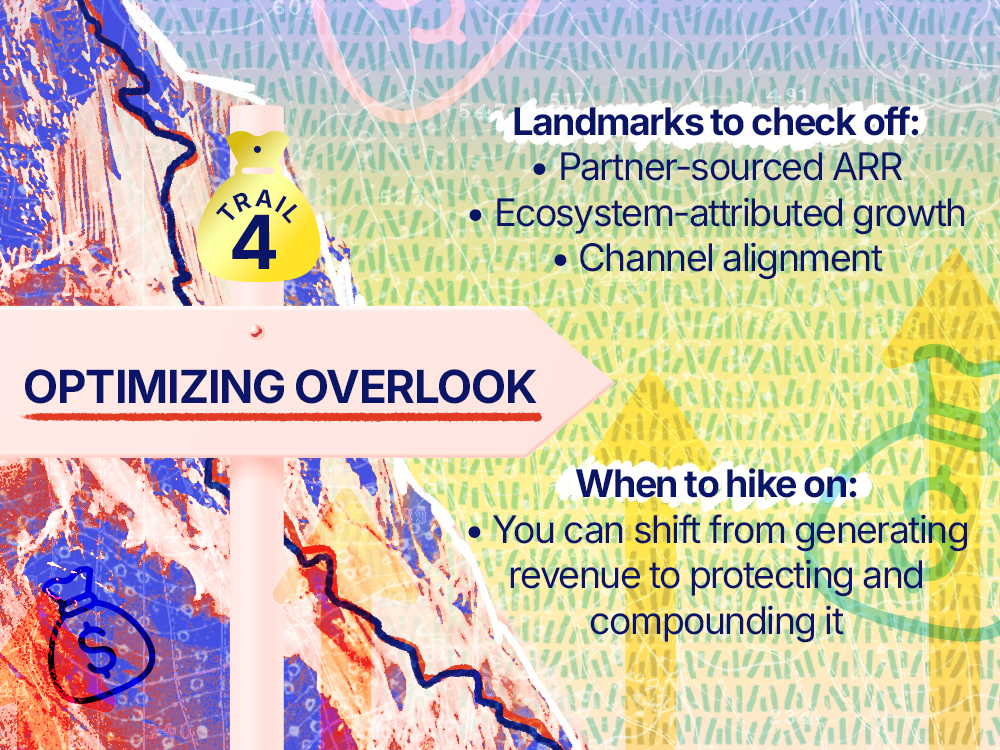
The optimizing stage is where the partner program becomes a strategic growth pillar for the organization. Multiple partner types run simultaneously, each with its own economics and progression criteria. The team is multi-functional, and what matters is stability.
Printify represents a different face of optimizing. “They send a regular newsletter to their affiliates. One half is teaching them about Printify; another half is how to be a better affiliate marketer,” Faber explains. “They’re so established, they’re going to tell you how to do your job and deliver value by teaching you how to be a better business person.”
This level of partner engagement, where the company invests in helping partners succeed, is what separates optimization from every earlier stage.
Pipedrive tells a similar story. The sales CRM manages over 700 partners across three programs — Solution Providers, Affiliates and Technology Partners — and continues to explore new ways to keep them engaged through training modules and enablement resources. The team is lean and is supplemented by an external agency.
KPIs at the Optimizing stage
- Partner-sourced ARR: Revenue directly attributed to partner activity.
- Ecosystem-attributed growth: 74% of SaaS companies say partners are essential to retention.
- Channel alignment: Are programs reinforcing each other? Are teams on the same page with priorities?
GTM motions at the Optimizing stage
- Ecosystem-led growth: Joint launches, shared acquisition and cross-selling. 48% of organizations say partners shortened their sales cycles.
- Partner enablement as value delivery: Teaching partners to run better businesses, not just sell your product. Just like Faber mentioned, Printify is actively doing this.
- Continuous refinement: Upgrading programs based on data, not launching new ones.
How to keep optimizing
Revenue is the north star at this stage, but the work shifts from generating it to protecting and compounding it. The companies that stay optimized focus on reducing partner churn by consistently delivering value, identifying cross-sell and expansion opportunities across partner-sourced accounts, and ensuring every channel contributes to ARR.

How to use this framework to elevate your partnership program
Whether you’re building from scratch or refining what’s already in place, here’s how to apply this framework effectively:
- Identify your stage: Audit your team, technology and GTM motion. Is your approach reactive, repeatable, multi-track or ecosystem-led?
- Plan the next milestone: For example, Campaign Monitor is finding more successful partners at the exploring stage; they are not building an advisory council just yet. Each stage has its own work.
- Make the case internally: Show your executive team where you sit, what the next stage requires and what investment is needed to get you there. This way, you can get more internal buy-in.
- Give partners the resources to succeed with you: The best programs at every stage invest in enablement — whether that’s a simple application form at Exploring or a full training newsletter at Optimizing.
- Don’t skip stages: Pipedrive built advisory councils only after multiple channels were running. In companies at the Building stage, affiliate had to work before they could shift to agencies.
Start where you are
Every partner program follows a path. From Campaign Monitor, figuring out whether its first successful partner is repeatable, to Pipedrive, orchestrating a stable partner ecosystem, the progression is the same.
The companies that move through these stages deliberately turn partnerships into a predictable revenue engine. The ones that stall are usually trying to skip ahead.
Benchmark where your program sits today. Share it with your executive team. “The key to partnership success is flexibility,” Faber says. “PartnerStack is the most flexible solution out there that will allow you to explore every avenue for success.”
So benchmark honestly. Invest in the stage you’re in. Then build toward the next one.