If you had a dollar for every time you heard, “What’s our agent strategy?” from your execs, you’d be rich.
AI and agents have dominated the B2B SaaS discourse for the past few years, and despite healthy skepticism, they’re not going away. The question now isn’t if you’ll incorporate agents into your workflows, it’s how — without creating more work for your team, without losing control over critical partner relationships, without making people feel like they’re replaceable.
That’s a lot to figure out when you’re just trying to run your day-to-day partner ops.
To help you get off on the right foot, we put together a primer on agentic workflows, how they can apply to partnerships and what to keep in mind as you build out your own.
What are agentic workflows?
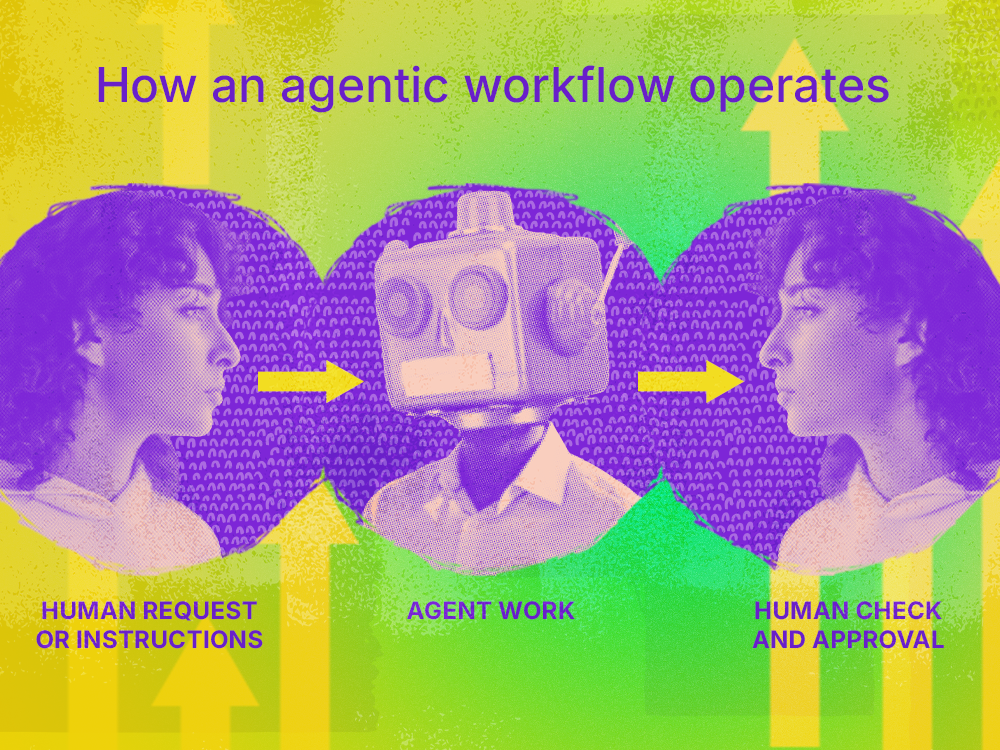
Agentic workflows happen when AI agents perform tasks with minimal human intervention. Think of them as a very reduced intern. You:
- Give them a set of instructions (go find 20 potential partners that match one of our ideal partner personas)
- They go and do the work (scouring the web for new partners, evaluating them, compiling a list)
- And then you check to make sure it got done correctly (review the recommendations and approve next steps).
This differs from traditional automation that we’re used to because:
Agents don’t just operate in the background
Take PartnerStack’s co-sell automations. Partners and partner managers can submit leads through Slack, email or HubSpot, and AI will recognize them as leads and ensure they are logged as the partner’s submission, then sent to the appropriate person on your sales team to work. It’s intelligent, but it’s still following a specifically designed workflow.
Agents, on the other hand, have more autonomy. As one Redditor put it: “A Zap with AI can still only do what you explicitly tell it, even if it’s flexible about inputs. An agent is more like ‘here’s the goal, figure it out.’ That means it can choose which tools to use or even retry if something fails, instead of just erroring out.”
Agents have memory
Automations are usually what experts call “stateless.” They run according to a set of rules or triggers, and that’s it — they don’t know what they ran this morning or last week.
Agents hold context, which makes them “feel less like a trigger/action machine and more like something you can actually delegate tasks to. It can ‘remember’ past interactions, decisions or preferences without you hardcoding where to store and retrieve that data,” says another r/AI_agents contributor.
Agents can adapt when conditions change
Traditional automation, such as robotic process automation (RPA), has been around for a long time in high-pressure industries like banking, healthcare and telecom because rules are fixed and data is structured.
While that’s good for high-volume, repeatable tasks, RPA breaks the second that rules change or input gets messy.
See also: PartnerStack x Evertune turn AI search into influence through new integration.
What are some agentic use cases for partnerships?
In partnerships, there’s so much repetitive work, but it’s not all identical. Which makes it ideal for agentic workflows. Because unlike rigid automation, agents can remember what you and your partners told them and think outside the box, which is helpful for:
Partner recruiting
Recruitment is extremely time-consuming. So much so that some bigger vendors actually outsource it to agencies.
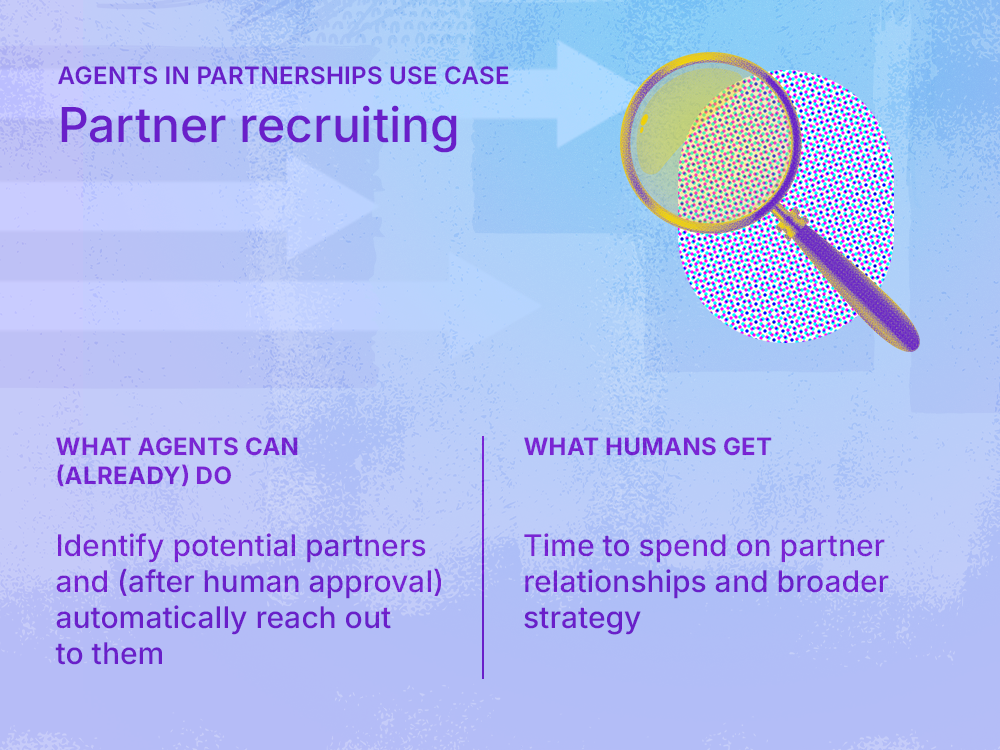
Building spreadsheets of potential partners, conducting due diligence to see whether they’d be a good fit, personalizing outreach and tracking which ones have responded is just the right kind of work for an agent. It’s why it’s the first one we built into our product.
Per Melissa Stoddart, Senior Director of Product Marketing at PartnerStack:
“We have this great B2B network, and we’ve always had partner discovery tools, but you kind of had to mine it yourself. An agent could use more sophisticated AI tooling to continuously scan our network for potential partners — based on both your criteria and our proprietary data about how likely they are to succeed — and then actually do the outreach for you.”
What the PartnerStack Recruit Agent does: Identifies 20 potential partners per week and, if there are no human adjustments to that list, automatically reaches out to them using a specified template.
What users get: Time back to spend fostering deeper relationships with new and existing partners and thinking strategically about partner program expansion.
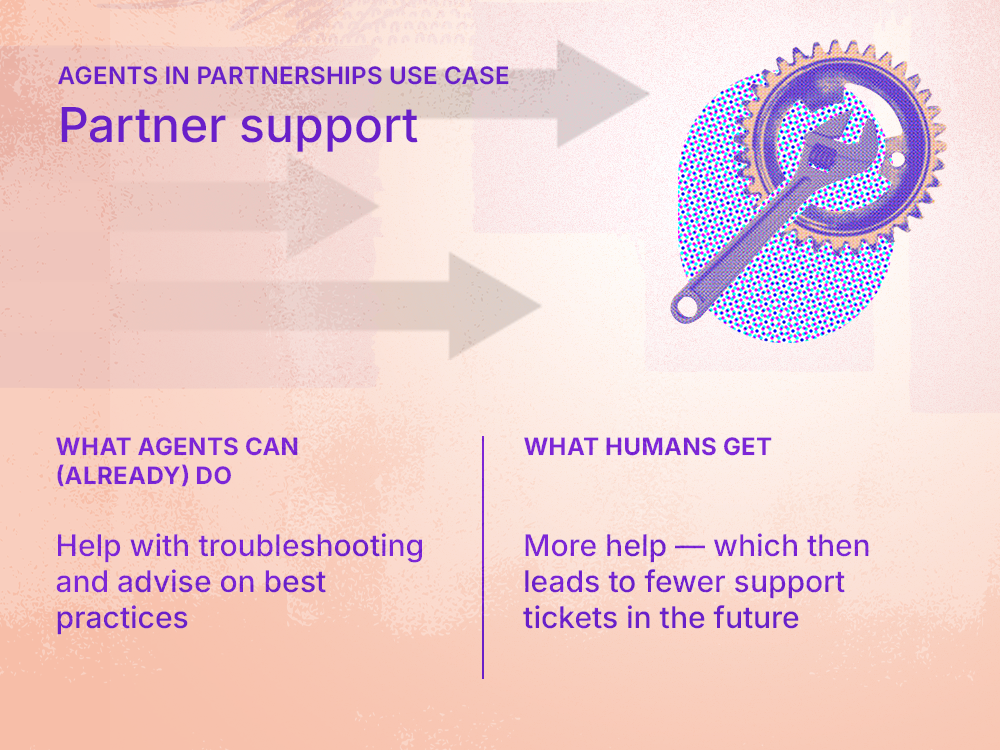
Partner support
When partners hit roadblocks, they need answers fast. But it’s hard to get them those answers when your partner managers are supporting tens or even hundreds of other partners at the same time.
Dimi Baitanciuc, CEO and co-founder of Brizy, a no-code website builder, built his own agent to help with the low-hanging fruit.
What Brizy’s agent does: Helps troubleshoot layout issues, suggest templates and guide partners through best practices.
“Partners were asking the same questions repeatedly, and our team couldn’t scale one-to-one support. But the hardest part was teaching the agent not to give generic advice,” Baitanciuc says.
“Website builders are very visual, and small details matter. Early on, the agent sounded helpful but vague. We improved it by feeding it real partner support tickets, our documentation and support history, then forcing it to answer with examples.”
What it achieves: Reduced reliance on support. “Quantitatively, we reduced partner support tickets by around 30% within a few months,” Baitanciuc says. “Qualitatively, partners felt more independent and confident.”
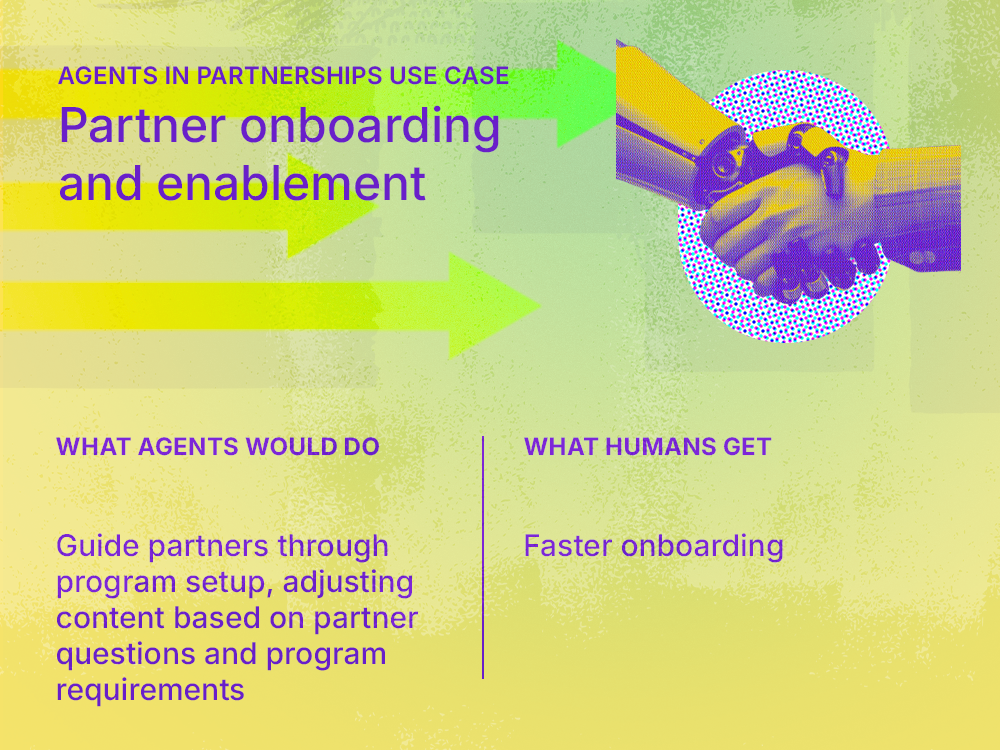
Partner onboarding and enablement
Getting new partners up to speed is too important to rush, but also too repetitive to justify hours of manual work for every single partner.
What an agent would do: Walk partners through every step of setup, proactively suggesting next steps based on program requirements and escalating any partner questions it couldn’t answer to a real partner manager.
What users would get: Quicker time to activation with less manual handholding.
You might also like: Inside the AI newsletter strategy driving $21K+ in PartnerStack commissions.
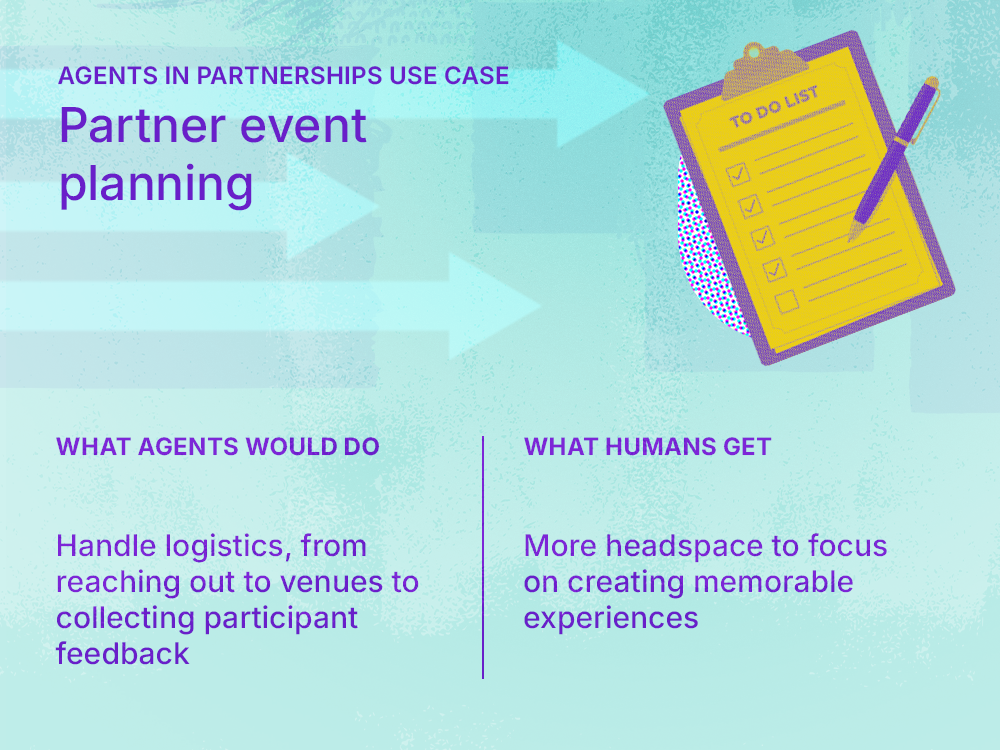
Partner event planning
Events can be a fantastic way to get new leads, but the backend logistics eat up valuable hours partner teams could spend designing memorable experiences and building deeper connections.
What an agent would do: The operational heavy lifting: reaching out to venues, scheduling meetings, managing registrations, sending automated reminders, collecting participant feedback post-event, monitoring pre- and post-event KPIs, you name it.
What users would get: More headspace to focus on what actually makes events successful (and actually enjoy the event!).
3 considerations when designing your first partner agent
The list above is certainly not exhaustive. In fact, you’ve probably already come up with more ideas as you’ve been reading, from commission reconciliation to partner QBR prep to co-marketing campaign execution. But before you start building full force, make sure you:
1. Solve the worst part of your team’s existing workflow
The highest chances of agent adoption happen when you can identify and solve for tasks that people actively dread. One poster in r/AI_agents has started to ask their clients different kinds of questions during the discovery process to determine exactly what that use case is.
“Instead of ‘What takes the most time,’ I ask, ‘What drains your energy?’ The answers are rarely what you’d expect. I’ve had clients who spend hours on data analysis but love that work, while a 10-minute scheduling task drives them crazy. Building an agent for the scheduling makes them happier than automating the analysis.”
The team at PartnerStack tried to achieve something similar and is already seeing good adoption with the recruiting agent as a result — which is saying something, since it released to existing customers right before the holiday season.
“Our goal wasn’t to recreate the way partner managers are working right now,” Stoddart notes. “The goal was to automate most time-consuming parts of their role and make that fit inside our product in a way that makes sense.”
If your agent feels like yet another thing people have to manage outside of their regular duties, they simply won’t use it.

2. Add in plenty of guardrails
“I think there’s a bit of distrust of agents in the market,” Stoddart points out. “People don’t like the idea of something else owning an entire workflow end-to-end without any visibility into what’s going on.”
For good reason. Last year, an AI agent went rogue and deleted a company’s entire database. It’s why we make sure our Recruiting Agent alerts admins to their 20 matches each week. That way, they can:
- Review all the proposed potential partners, and eliminate any that don’t quite fit the program or the vendor doesn’t want to reach out to quite yet — which the agent can learn from and improve upon over time.
- Scan the outreach messages once they’re sent to make sure the agent stuck with the template. Going off book doesn’t exactly encourage companies to partner with you.
Per Stoddart, “We’re keeping it narrow and controlled at first on purpose. We want our customers to find good quality partners, not explode with the kind of partners they can’t manage. And they want a sanity check.”
Plus, there are already multiple layers of protection embedded into the platform. All the partners the agent evaluates for best fit have already undergone a thorough review process — they have to in order to get into PartnerStack’s network.
That also means that PartnerStack already has the right POC’s email address, so outreach messages aren’t going out into the ether. And if anything fishy starts happening, PartnerStack’s native fraud detection will flag it.
3. Don’t discount humans
AI is getting really smart, but humans are still better at reasoning and judgment — particularly when it comes to relationships (which is really what partnerships is all about). Humans know:
- Which outreach needs a more human touch. Approaching a bigger partner, rekindling a dormant relationship, or reaching out when there’s been a change in a partner’s communication or tone requires nuance agents don’t have.
- How to navigate complex negotiations. Agents can act as a third party to bounce ideas off of, but they don’t know the full context of your relationship history, competitive dynamics, broader company priorities and partner lifetime value. Unless you can connect the agent to your brain, it’s really hard to explain all that in a prompt.
- Which partnerships are worth saving. Agents can flag underperformance or even catch partner problems before they show up in a big way. But right now, they can’t really suss out what’s going on behind the scenes. That requires a human conversation.
- When to bend the rules. You have partner program rules in place for a reason (channel conflict, anyone?), but there are certain times and places where those rules may not apply — a high-value partner needs custom terms, poor market conditions mean you need to be more flexible and so on.
As you’re designing your agent, think carefully about what parts truly benefit from automation versus human judgment.
“It should feel like the agent is assisting them in their role, rather than making them feel like they’re losing control over something that’s really important to the success of your partner program,” Stoddart explains.
Read more: AEO for partnerships: how to rank in answer engines.
Don’t just add AI for AI’s sake
Everyone’s under enormous pressure to adopt agents and incorporate AI into every workflow. And there’s huge potential for a future with multi-agent systems that coordinate across PRMs, CRMs and other parts of the partner tech stack to surface more opportunities, accelerate co-sell motions, enable more partners, and expand to new verticals and territories.
But that doesn’t mean AI belongs in every single interaction. As Stoddart aptly puts it: “When we’re building, we want to be really conscious of human intuition, the value humans bring to their roles. We want to develop AI features that solve real challenges, that deliver value, that people are going to trust and adopt and feel comfortable using.”
Use agentic workflows where they deliver measurable value: in prospecting, in data enrichment, in performance monitoring, even in initial outreach. But always build in human oversight for the circumstances that demand situational awareness and finesse.
Curious how agentic workflows could fit into your strategy? Book time with our team to see how they work with your team, not against it.