For years, the question was fairly simple: where does your brand rank on Google? That’s no longer the whole picture. Today, buyers are increasingly turning to ChatGPT, Gemini, Perplexity and other AI-powered search tools to find software — and the brands showing up in those answers aren’t always the ones winning in traditional search.
It’s no longer enough for SaaS companies to rank well in search. Teams also need to understand whether AI systems mention their brand, how those systems describe it and whether they’re showing up when buyers ask the questions that matter.
The problem is that most teams have no benchmark. What does good AI visibility actually look like?
To answer that question, PartnerStack turned to insights from AthenaHQ's platform data covering 1,259 actively tracked B2B SaaS brands and more than 4.3 million AI responses across ChatGPT, Gemini, Claude, Perplexity, AI Overviews, Google AI Mode, Copilot and Grok.
The insights reveal where visibility is concentrated, which signals matter most and what top-performing brands are doing differently.
The data points to four consistent themes:
- AI visibility is increasingly concentrated among a small group of brands.
- Third-party validation shapes how AI systems recommend vendors.
- Visibility varies meaningfully across AI platforms, which makes single-platform measurement unreliable.
- Appearing in AI-generated answers is not enough. Accurate representation matters as much as frequency.
The AI visibility gap is wider than you think
The data makes one thing clear: the gap is bigger than most teams expect.
According to AthenaHQ’s data, the median B2B SaaS brand appears in AI-generated answers 31.2% of the time. Brands in the top 10% appear 63.8% of the time or more. Brands in the bottom 10% appear just 5.7%.
That’s an elevenfold difference between the strongest and weakest performers across the same category queries.
It isn’t simply that some brands are doing better than others. It’s that AI visibility is becoming concentrated among a small group of companies.
The brands appearing consistently in AI answers are pulling further ahead every month. Those sitting at 5% aren’t losing ground slowly. They’re becoming unreachable during the research phase, before a buyer has spoken to a sales rep, visited a website or clicked a single ad.
You might also like: Answer engine optimization: The ultimate 2026 guide for B2B SaaS teams.

Which signals drive visibility?
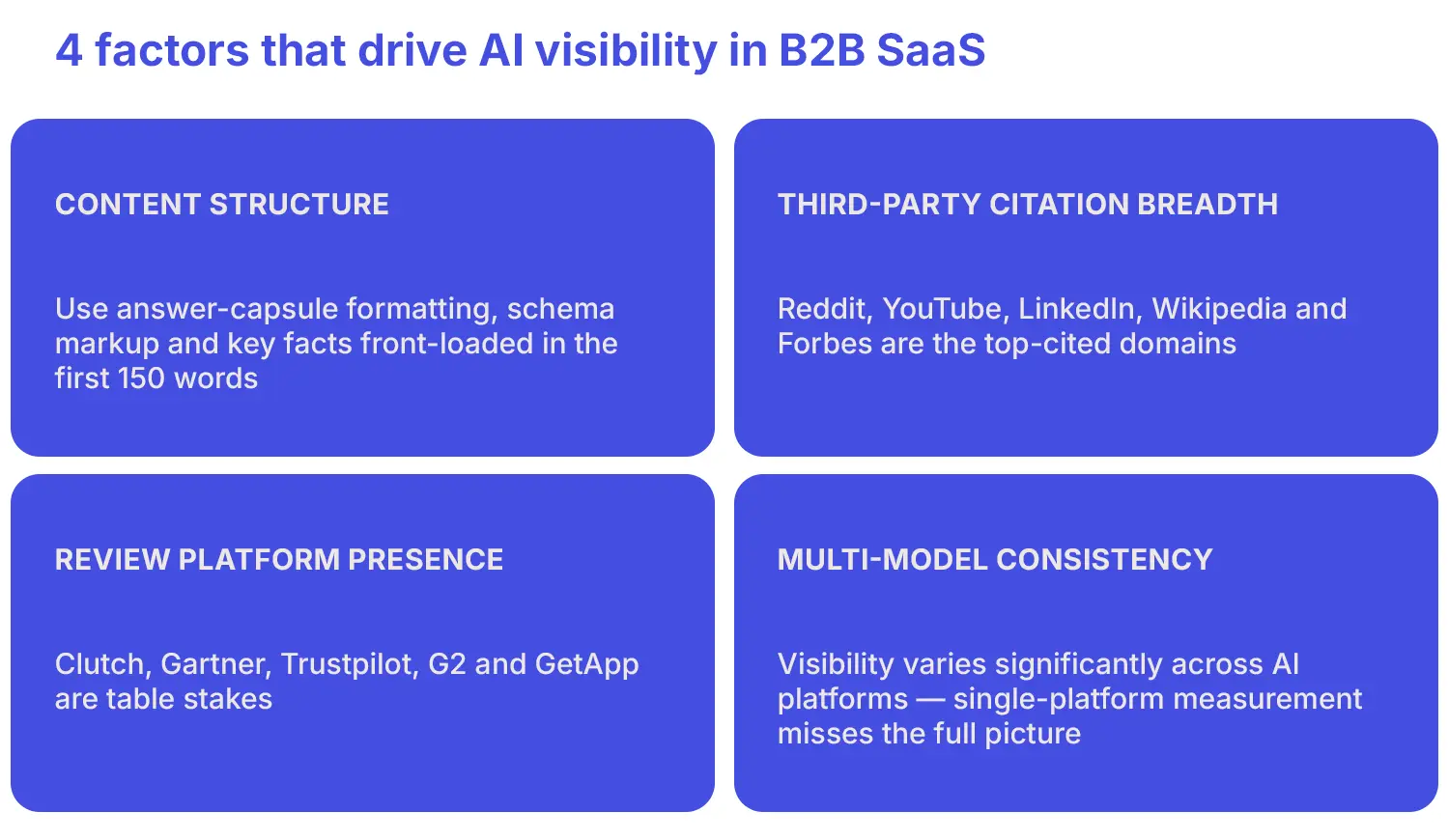
Four factors consistently separate high-visibility brands from low-visibility ones:
1. How content is structured:
Pages with answer-capsule formatting (i.e., leading with a direct, self-contained answer before elaborating), schema markup and factual claims front-loaded in the first 150 words get cited far more often than pages that bury key information.
2. Third-party citation breadth:
Reddit is the single most-cited domain in AthenaHQ’s 90-day data, with over 69,000 citations. YouTube follows at more than 40,000. LinkedIn, Wikipedia and Forbes round out the top five.
AI systems use these sources to validate what brand-owned content claims. A brand that lives only on its own website is essentially asking AI to take its word for it.
3. Review platform presence:
The platforms most frequently cited as sources in AI responses are Clutch (2,115 citations), Gartner (1,822), Trustpilot (1,099), G2 (1,090) and GetApp (713). Presence on these platforms isn’t a differentiator, it’s table stakes. Brands without active profiles on at least a few of these are starting from a structural disadvantage.
4. Multi-model consistency:
Among brands tracked across all major AI platforms and model families, 15.5% show a spread of more than 30 percentage points between their best and worst-performing model. ChatGPT and Gemini correlate closely at 0.908 across 693 tracked brands. ChatGPT and Perplexity drop to 0.838.
That gap might sound small. For a brand sitting at 40% visibility on one platform and 10% on another, it represents an entirely different buyer experience depending on which tool they’re using that morning.
The models don’t behave the same way
One of the clearest findings in AthenaHQ’s data is how differently individual AI systems treat brand recommendations.
“Our sentiment data shows 7 to 11% of brand mentions carry negative sentiment across models, often driven by outdated or third-party content the brand does not control,” notes Willson Liu of AthenaHQ.
Grok in particular skews negative, with 21.6% negative sentiment on brand mentions — roughly twice the rate of other models.
Teams measuring visibility on a single platform aren’t seeing their AI presence. They’re seeing one angle of it. Mention rates alone vary significantly by model. Grok produces the highest overall mention rate at 41.7%, in part because it tends to name more brands per response. Perplexity sits at the other end at 21.3% — the most selective of the eight models tracked.
That spread isn’t random. Each model pulls from different sources and weighs signals differently. A brand that performs well in ChatGPT, for instance, may be nearly absent in Perplexity. As Liu notes, “Perplexity’s real-time retrieval architecture favors Reddit, niche directories and recent data-rich content — signals many SaaS brands haven’t optimized for.” Brands that haven’t invested in community-level presence don’t just underperform on Perplexity — they’re missing from the sources Perplexity draws on.
What top-performing brands are doing differently
The brands with the strongest AI visibility haven’t stumbled into it. They’ve built the infrastructure for it, even if they haven’t always called it that.
The difference comes down to three things:
- They own the category narrative across multiple content types: comparison pages, use-case pages, competitor alternatives and structured documentation that positions them relative to the field.
- They show up consistently across third-party domains rather than relying on owned channels alone.
- They maintain coherent entity signals (consistent structured data that helps AI systems identify and trust a brand): consistent naming conventions, aligned positioning across owned and third-party channels, schema markup and Knowledge Panel presence.
The gap is measurable. Among the 1,259 brands in AthenaHQ’s dataset, 287 brands average a 73.6% mention rate — meaning they appear in nearly three out of four AI-generated responses to relevant category queries. The next tier down averages 48.5%. That’s not a small gap — it reflects a fundamentally different approach to how these brands show up across the web.
See more: Answer engine optimization for SaaS: The partner-led playbook for LLM recommendations.
Causes of lower AI visibility
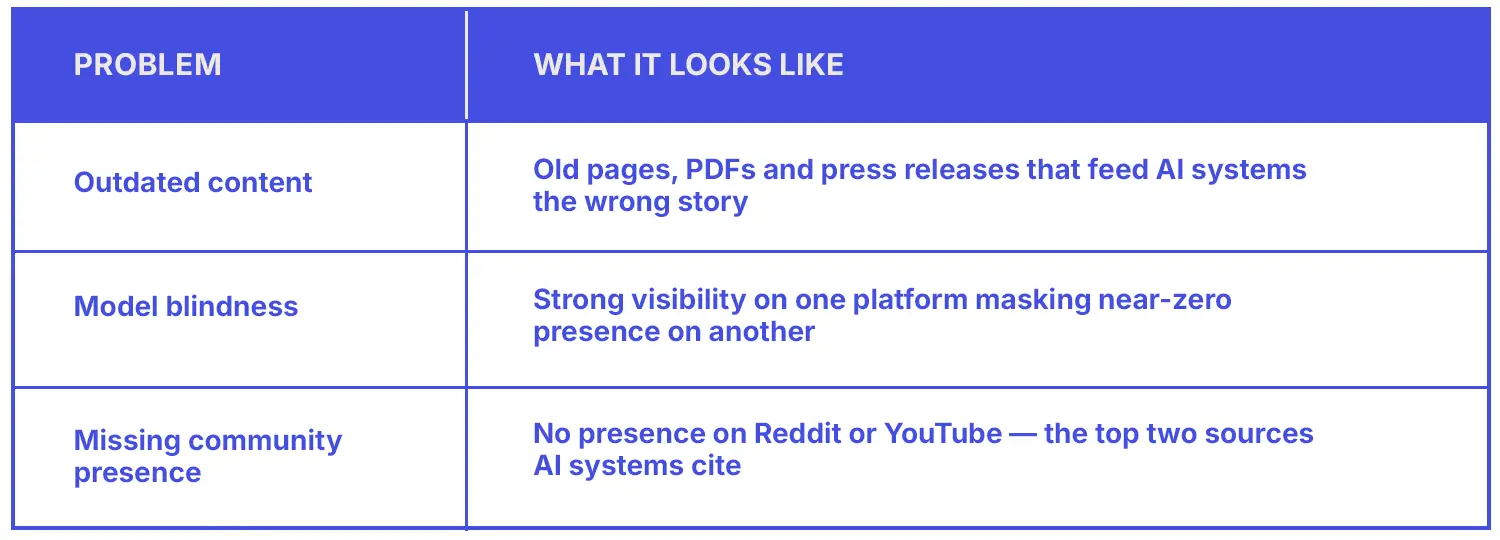
The brands at the bottom of the visibility distribution typically share three problems:
1. Outdated content. Archived press releases, stale product pages and old PDFs that were never properly redirected don’t sit harmlessly in a corner of the internet. They surface in training data and real-time retrieval, creating misrepresentation risk that grows quietly over time.
2. Model blindness. Brands that check visibility on one model assume they understand their full AI presence. A brand with 68% visibility on Gemini could have just 25% visibility on Perplexity, with each model drawing on entirely different third-party sources to construct very different narratives.
3. Absence of community-level content. Reddit and YouTube are the top two most-cited source domains in AthenaHQ’s 90-day pitch data, yet most B2B SaaS brands have invested almost nothing in either.
How to build an AI visibility program
Most brands are further behind than they realize. AthenaHQ’s pitch data — drawn from 9,645 unique audits and more than 532,000 AI responses — shows the average brand starts with a 19.4% mention rate. Nearly half (44.2%) fall below 10%.
Strong AI visibility is the exception, not the norm. The brands that move now have a structural advantage that won’t be easy for latecomers to close.
The sequence that works:
Step 1: Measure first
Establish a baseline across major AI platforms before anything else. Identify which models generate visibility, where gaps exist and how sentiment varies. Without this foundation, effort gets distributed based on assumptions rather than evidence.
Step 2: Fix content structure
Surface definitions and factual claims in the first 150 words. Remove or redirect outdated PDFs and archived assets. One brand in AthenaHQ’s data moved from 0% to 55% citation rate across ChatGPT, Perplexity and AI Overviews in 90 days by restructuring the opening paragraphs on eight high-traffic posts.
Step 3: Build external validation
Update and maintain review profiles on Clutch, Gartner, Trustpilot, G2 and GetApp. Make community participation deliberate rather than incidental. Treat third-party coverage as a planned objective. Identify the forums, publications and communities where your category is discussed and earn a consistent presence in those spaces.
Step 4: Expand ecosystem content
Integration pages, marketplace listings and co-authored partner content create citation opportunities that owned channels can’t replicate. Brands with strong partner programs have a compounding structural advantage here that most haven’t fully activated.
Related: Why your affiliate program is also an AI visibility strategy.
AEO implementation: Tools and tactics
Any monitoring setup covering only one AI model gives a partial picture. Tracking visibility across multiple systems is the baseline requirement — and that’s what AthenaHQ is built for.
A useful AEO monitoring setup covers the following areas:
Cross-model tracking: Monitor visibility across multiple AI models rather than a single platform. For example, AthenaHQ tracks eight models and surfaces mention rate, sentiment and ranking position across all of them, which is what makes comparative benchmarking possible.
Citation tracking: Identify which PR stories, thought leadership articles, product pages and third-party sources are influencing AI-generated answers — and monitor which are being referenced most frequently so teams can strengthen the signals most likely to influence future answers.
Sentiment monitoring: Track whether AI mentions are positive, neutral or negative. Mention rate without sentiment data misses a critical dimension. As Liu notes, being mentioned negatively can be worse than not being mentioned at all.
Competitive benchmarking: Compare visibility, share of voice and sentiment against competitors to understand where a brand is gaining or losing ground in AI-generated results.
The path to AEO maturity
AEO maturity isn’t a project with a finish line. It’s a set of habits that build on each other, and the sequence matters as much as the actions themselves.
This month
- Audit visibility across models, not just one. Most brands are blind to their Perplexity gap, and Perplexity is the worst-performing model for the majority of B2B SaaS brands.
- Confirm listings on Clutch, Gartner, Trustpilot, G2 and GetApp. These consistently appear among the most-cited sources across AI response data and are not optional for any brand that wants to show up reliably.
- Restructure top pages to front-load factual claims within the first 150 words using answer-capsule formatting. Per AthenaHQ’s data, this is one of the highest-ROI changes a brand can make.
Next quarter
- Build Reddit and YouTube presence. Reddit is especially powerful for Perplexity given its real-time retrieval architecture, and community-level content builds the kind of presence AI systems actually pull from.
- Create structured comparison and category pages. Top-tier brands consistently own the category narrative across models rather than relying solely on their own brand page.
Next 6 to 12 months
- Invest in entity authority through schema markup, Knowledge Panel presence, Wikipedia-eligible notability signals and sameAs links across authoritative directories.
- Monitor sentiment continuously. AthenaHQ’s data shows mention rates can shift several points month-over-month, and old content creates misrepresentation risk.
According to AthenaHQ’s data, the sources influencing AI recommendations can shift significantly month-over-month, meaning AI visibility isn’t something teams can measure once and move on from.
For a broader look at how AI search is evolving, AthenaHQ’s 2026 State of AI Search report is a useful resource.

AEO readiness checklist
Visibility Measurement
□ Track visibility across multiple AI models
□ Monitor mention rate monthly
□ Track sentiment alongside mentions
□ Benchmark against competitors
Content & Documentation
□ Front-load product definitions and key claims within the first 150 words
□ Use clear section hierarchy
□ Implement relevant schema markup
□ Keep documentation publicly accessible
□ Remove outdated PDFs and archived assets
Third-Party Validation
□ Maintain profiles on G2, Gartner, Clutch, Trustpilot and GetApp
□ Build visibility on Reddit and YouTube
□ Earn mentions from industry publications and niche directories
□ Monitor and respond to reviews regularly
Partner Ecosystem
□ Publish public integration pages
□ Create co-authored content with partners
□ List and showcase partner relationships publicly
□ Encourage partner-generated content
Entity Consistency
□ Use consistent product naming everywhere
□ Align positioning across owned and third-party channels
□ Update outdated descriptions
□ Run regular audits of how AI systems describe your brand
You might also like: How partner leaders can help marketing win AI visibility and prove AEO ROI.
The partner ecosystem effect
Most of what drives AI visibility comes down to one thing: how many independent sources are telling the same story about your brand. Content structure, review profiles, community presence — all of it is building a signal network that AI systems can cross-reference and trust.
Partner ecosystems are where that network compounds fastest. PartnerStack’s data shows 43% of citations in AI-generated answers about top vendors originate from partner sources: integration pages, marketplace listings, co-authored content, customer stories.
The brands winning in AI search aren’t just optimizing pages — they’re building ecosystems. This piece draws on insights from AthenaHQ, whose AI visibility tracking makes benchmarking possible at scale. PartnerStack helps SaaS companies build the kind of partner programs that generate those signals. Book a demo to see how it works.
Methodology
The data in this piece comes from AthenaHQ's AI visibility platform. The dataset covers 1,259 actively tracked B2B SaaS brands and more than 4.3 million AI responses across ChatGPT, Gemini, Claude, Perplexity, AI Overviews, Google AI Mode, Copilot and Grok.
AthenaHQ calculates a brand’s share of voice across AI models by issuing structured queries relevant to a brand’s category, tracking whether and how the brand appears in each response, and aggregating those results into mention rate, citation rate, sentiment and rank position metrics.
The benchmarks in this piece reflect a 30-day tracking period across 1,259 brands with a minimum of 100 responses each, plus 90-day pitch audit data covering 9,645 unique audits and more than 532,000 AI responses.
Because AI citation patterns shift regularly, teams should treat these as baselines rather than fixed benchmarks and revisit their own visibility metrics periodically.
This piece was produced by PartnerStack with insights from AthenaHQ.