It used to be that we only had to worry about search engine optimization (SEO). Google had a tightly guarded ranking algorithm that we were constantly trying to figure out.
Now Google isn’t the only show in town, and SEO isn’t the only thing keeping partnership leaders up at night. They’re now navigating generative engine optimization (GEO) and answer engine optimization (AEO), and answer engines like Copilot, ChatGPT and Google AI Overviews each run on different citation logic.
LLMs don’t recommend brands because they have great websites. They recommend brands that are consistently validated across the third-party ecosystem — which is exactly where your partner program comes in. We turned to Taylor Kendrick, Director of Partnerships at PartnerStack, to break down how to make it work.
Recommendation visibility is a different problem than ranking visibility
Before building a partner-led AEO strategy, it helps to understand why recommendation visibility and ranking visibility are different problems — and why solving one doesn’t automatically solve the other.
Why being indexed isn’t the same as being recommended
Success in SEO and AEO for SaaS may overlap, but it’s equally possible for them to be mutually exclusive. You can have a piece of content that ranks well, but it’s not being seen as a recommended solution. At the same time, you may have something that’s frequently cited in AI-generated answers, but it’s nowhere near the top organic rankings.
Both areas are complex, but in their simplest terms, SEO is all about optimizing your content so it ranks well. On the other hand, partner-led AEO is about structuring and distributing content so it surfaces throughout a customer's buying journey.
“It's different from traditional partner SEO because you're not optimizing for a crawler's index. You're optimizing for a language model's retrieval logic,” says Kendrick.
He adds, “The fundamentals of great content still matter, but the structure and distribution requirements are completely different — and most partner teams haven't caught up yet.”
How citation behavior differs across ChatGPT, Google AI Overviews and Copilot
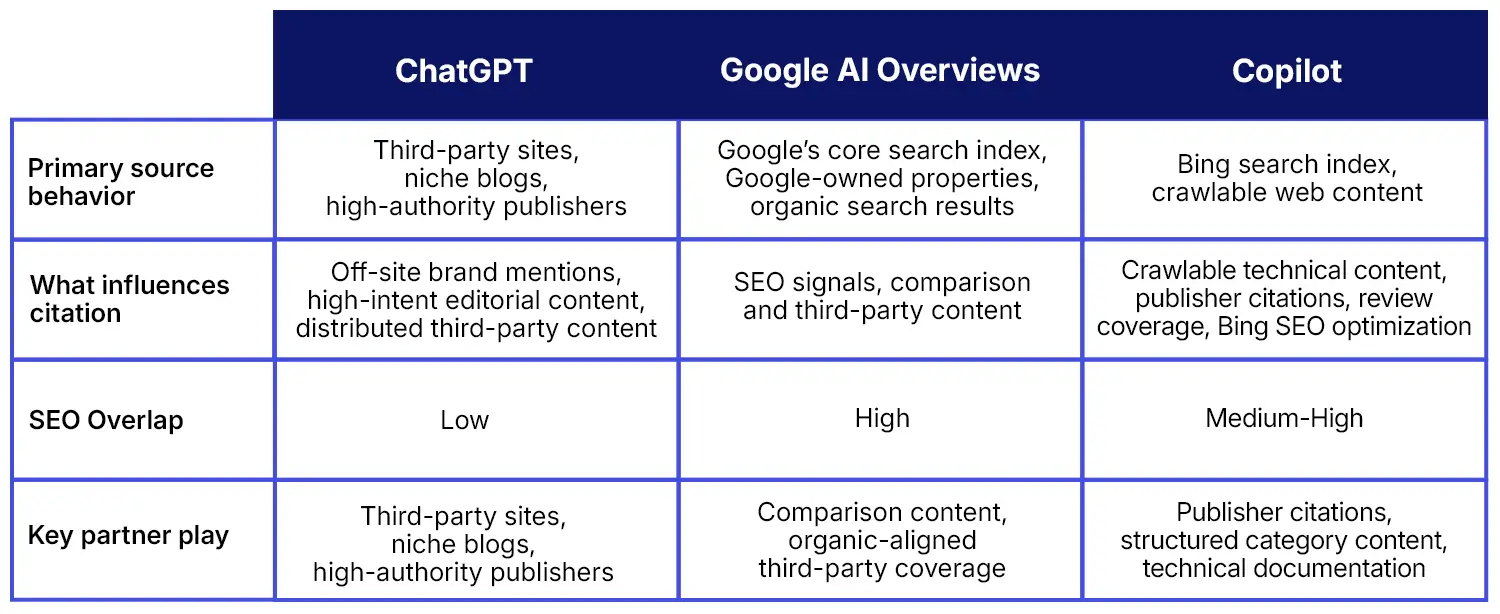
None of the major players have fully disclosed how their citation and recommendation systems work. However, their answers appear to draw from a mix of on-site content, third-party sources and broader web signals. Experts have observed the following citation behaviors for LLM recommendations:
- ChatGPT seems to favor well-established websites, like Wikipedia and Reddit. That said, it also turns to niche blogs that have built their topical authority.
- Google AI Overviews overlap more with their traditional search results. They frequently cite their own owned properties, such as Google Reviews and YouTube.
- As a Microsoft offering, Copilot relies on the Bing search index for its citations. Success in Bing search often correlates with stronger visibility in Copilot citations.
Why partner-led AEO works for SaaS
The reason partner-led AEO is so well-suited to B2B SaaS comes down to two key things: how B2B buyers make decisions, and what AI systems need to make recommendations.
B2B buyers trust third-party validation during evaluation
B2B buyers are increasingly turning to AI chatbots during the research phase. According to G2’s 2026 AI Search Insights Report, half of B2B software buyers now begin their research with an AI chatbot more than with Google, up significantly from the year before.
B2B marketers have mastered and gamified SEO over the years to the point where B2B buyers know they have to sort through a lot of brand-optimized content to find genuinely useful information.
On the other hand, LLM recommendations are seen as less filtered — they can surface a broader range of solutions from different sources than a traditional search results page.
Partners create the corroboration layer LLMs need
The good news is that the rules of engagement in answer engine optimization for SaaS favor you right now. You can leverage your partners to create the type of content that LLMs cite and B2B buyers trust. In fact, Kendrick says there will never be a better time to do it.
“It's never going to be cheaper to do AEO work than it is right now. Publisher prices are going up, and there's already a pricing model shift happening,” Kendrick says. “Many publishers are moving away from pure performance models toward lump sum arrangements, partly because direct click conversions have softened.”

The partner motions that influence LLM recommendations
Not all partner content contributes equally to recommendation visibility. Here’s how each partner type creates a distinct type of citation signal.
Publisher roundups and category listicles
Roundups and listicles remain as valuable in partner-led AEO as they’ve always been in SEO, provided they are high-quality and structured the right way.
Think: SaaS category pages and roundups like “the best project management software”, or “top CRM platforms for startups.”
Affiliate reviews and comparison pages
Affiliate content often taps into buyer-intent searches and evaluation-stage questions.
You might consider:
- Product A vs Product B
- Best alternatives to [competitor]
- Detailed software reviews
The deeper the niche, the more you can build topical authority.
Kendrick has also observed something counterintuitive about which affiliates actually get cited: it's not always the biggest names.
“What’s surprising: some mid-authority affiliates with very specific niche audiences are getting cited more than high-DA generalist sites because their content is more precisely structured around the query patterns AI systems are trained on,” he says.
Creator explainers, tutorials and niche expert commentary
Legitimately helpful content has always performed well. In AEO, that’s especially true: genuine expertise is exactly what citation engines are looking for.
Consider formats like:
- YouTube walk-throughs
- Podcasts with experts
- Technical tutorials
These formats reward real subject experts who dive deeper — that’s why ranking and citation engines love them.
Integration pages, communities and solution-partner content
Many SaaS teams are already sitting on underused AEO assets. Things like integration landing pages and community knowledge bases contain detailed niche conversations that can build your authority.
.webp)
The model-specific playbook
ChatGPT, Google AI Overviews and Copilot don’t behave the same way as each other — and so the partner plays that work best for each are also different.
ChatGPT: brand mentions, citations and discoverability
Too many marketers are treating ChatGPT like Google, and trying to win on their own website.
It’s less about optimizing your own properties and more about trying to own more of the conversations that take place away from your website. That’s what builds real topical authority in ChatGPT outputs.
That means spending more time working on your presence in independent publisher content, review platforms and comparison articles — the brand mentions and third-party citations that build real discoverability in ChatGPT.
Google AI Overviews: search-derived evidence and comparison sources
AI Overviews may not be the first tool buyers reach for, but it’s closing the gap fast.
This means that your existing SEO investments likely aren’t wasted here: AI Overviews is built on top of Google search, so the same signals that help you rank tend to support your visibility in AI-generated answers, too. For now, success with Google AI overlaps significantly with organic search success. Your SEO playbook still matters. Just make sure comparison content and third-party sources are part of your organic strategy, since AI Overviews pulls heavily from those.
Copilot: Bing-grounded results and cited answer surfaces
Bing becoming a major player in 2026 may come as a surprise for some, but earning Copilot citations has quietly become worth prioritizing — and its Bing foundation makes the path to visibility more straightforward than you might expect.
Right now, Copilot’s engine appears to be favoring:
- Crawlable content
- Publisher citations
- Review coverage
- Industry references
- Structured category positioning
How to brief partners for AI-era distribution
Having the right partner types in place is only half the equation. What you brief them to create — and how consistently — determines whether those partnerships actually impact recommendation visibility.
Define the claims, categories and proof points that matter
Kendrick notes that improving partner-led AI visibility starts with arming your partners with what they need to help you.
“Brief your top publisher partners on what ‘good’ looks like for AEO — give them the positioning, the comparison angles, the use-case specificity they need to write content that gets cited,” he says. “Most partners want to do this right, they just don't have the brief.”
Align messaging across partner content and owned pages
Your messaging may shift over time, which means partner content that was accurate six months ago may no longer reflect your current positioning.
“The role of the affiliate manager is fundamentally changing. It used to be about standing up content at scale. That's still part of it — but there's a new job now: monitoring and maintaining the content that's actually being cited in LLM responses,” Kendrick says.
“The affiliate manager of the future isn't just a content recruiter — they're a content accuracy layer. Almost no one has operationalized this yet,” he adds.
Beyond consistency, message alignment now also requires connectivity. Kendrick goes further, pointing to a coordination layer most teams haven't built yet:
“Getting affiliate articles to cross-reference each other — building a web of citations across your partner ecosystem — meaningfully increases the authority signal AI systems pick up on. It's the difference between isolated content and a content network.”
If you're looking for a starting point to improve partner-led AI visibility, Kendrick recommends prioritizing two actions in the first 60–90 days:
- Audit where you're currently showing up — and not showing up — in AI-generated answers for your top 5–10 purchase-intent queries. “This is table stakes,” he says.
- Brief your top publisher partners on what good AEO content looks like for your product: the positioning, the comparison angles and the use-case specificity that gets cited.

How to measure partner-led AEO
Measuring partner-led AEO isn’t like measuring traditional affiliate performance because AI-influenced buyers often never click a tracked link. You need different signals.
Prompt-set share of voice
For partnerships and marketing leaders, share of voice in AI-generated answers is the new keyword ranking — it tells you whether your brand is part of the conversation when buyers are actively evaluating solutions.
Create a standardized prompt set so you can track how often your brand appears relative to your competitors when it comes to:
- Category recommendations
- Alternative searches
- Use-case questions
For example, a basic prompt set might include:
- Category: "Best partner management software for mid-market SaaS"
- Alternatives: "Best alternatives to [competitor name]"
- Use-case: "How do I manage affiliate payouts at scale?"
Plan to revisit and update your prompt set regularly as the landscape evolves.
Citation share by partner type
This is where AEO measurement connects directly to partner program decisions: knowing which partner types are generating citation signals helps you allocate co-marketing budget and prioritize relationships based on AI visibility, not just traffic.
Identify which partnerships are generating the strongest recommendation signals by tracking which publishers, affiliates, creators and communities are being cited the most.
Influenced branded search, direct traffic and pipeline
Start tracking your business outcomes relative to your citation metrics:
- Branded search growth
- Direct traffic increases
- Demo requests
- Pipeline creation
- Assisted conversions
These metrics help determine whether your AEO efforts are having an impact. Because attribution undercounts AI-influenced buyers, these downstream signals are a strong proxy for whether partner-led AEO is moving the business.
You might also like: How to audit your brand’s AI visibility in 30 minutes.
What breaks partner-led recommendation loops
Partner-led AEO can be undone as easily as it can be built. These are three common failure points that can break recommendation visibility.
Off-message partner content
Kendrick is direct about the biggest threat: “Inconsistent messaging across the partner ecosystem is the biggest killer.”
“If your affiliates are all describing your product differently, AI systems get a confused signal, and either don't cite you or cite you inaccurately,” he says.
Thin affiliate pages and low-trust placements
Google and SEO began shifting towards a focus on quality in recent years, but in AI search, quality isn’t optional — it’s the baseline.
Kendrick is clear: “The quality bar is only going up. The affiliate programs investing in genuine, high-value content now are building a moat.” He warns that programs chasing volume instead will find themselves increasingly invisible as LLMs get better at filtering out low-value content.
See more: 25 AI affiliate programs to join to maximize revenue.
No feedback loop between AI visibility and partner management
Without a measurement framework, there’s no way to know what’s really working, or what’s quietly breaking. Kendrick identifies the second biggest AEO failure as treating it like a one-time project, rather than an ongoing program.
“You need to monitor, brief and iterate constantly.”
The window is still open
LLMs recommend brands that are consistently validated across the third-party ecosystem, and that validation doesn’t happen by accident. It’s built through a coordinated, partner-led content program — one that prioritizes genuine, high-value content over volume.
The teams that start now will be the ones showing up in AI-generated answers when it matters most.
As Kendrick puts it, “The ones chasing volume are going to find themselves invisible as LLMs get better at separating real value-add content from paid filler. The window to get ahead of this is open right now — but it's closing.”