AI is changing how buyers discover software, but most revenue teams still can’t see where that discovery happens.
Prospects now use tools like ChatGPT or Perplexity to research solutions, compare vendors and build shortlists before ever visiting a website. By the time they appear in analytics tools, the original influence is often buried inside direct or untracked traffic.
That’s the problem with AI search attribution — the process of understanding how AI-driven discovery influences buyer journeys and revenue. Traditional reporting was built around clicks and sessions. AI-driven discovery often happens before either exists, which means the signals that matter are indirect, delayed and easy to misread.
To understand how RevOps teams are adapting, we spoke with Ash Richardson, VP of Revenue Operations at PartnerStack. Her view is that AI attribution is really two separate problems: measuring whether AI is creating visibility, and measuring whether that visibility is driving revenue. Most teams are conflating the two — or missing both.
This article covers how to solve both, from CRM instrumentation and signal frameworks to attribution models and dashboard design.
Why AEO measurement breaks traditional attribution
Most teams notice the symptom before they understand the cause. Organic traffic flattens or declines while pipeline holds steady. The instinct is to question content performance, but the shift is structural.
"Teams see flat or declining organic traffic and assume their content isn't working," Richardson explains. "But they're measuring output of a distribution channel that's fundamentally changed."
AI tools now answer questions directly — zero-click discovery — without sending users to a website. Buyers compare vendors and form opinions inside AI tools without generating any analytics data. And by the time they arrive on a company’s website, they’re often already informed, showing up as direct or a branded search with no trace of how they got there.
The question traditional attribution was built to answer — did they click? — is the wrong one. As Richardson puts it: “Did AI cite you, did branded search go up, did someone show up to a sales call already informed? Those are the signals that tell you whether your content is building influence.”
You might also like: How partner leaders can help marketing win AI visibility and prove AEO ROI.

What RevOps should actually measure
AI influence doesn’t show up as one number. It surfaces across three layers of the funnel, and each one answers a different question.
Richardson frames the split cleanly: "AI visibility means your content is surfacing in AI-generated answers. That's measurable through tools like Perplexity tracking or manual query testing. AI-attributed pipeline means a deal traces back to that influence, which requires layering in self-reported data and CRM source hygiene. One is reach, the other is revenue. You need both, but they're different problems.”
Tier 1: Visibility signals
Visibility signals show whether a brand appears inside AI-generated responses and early research journeys.
Three metrics belong here:
- Prompt-set share of voice: the percentage of core buyer queries where your brand appears in the AI response, measured across a fixed set of prompts tested on a recurring basis
- Citation frequency: how often AI tools link to your domain
- Mention presence: a broader check on whether your brand is named at all, even without a citation
Visibility is an input, not an outcome — what matters is whether it’s moving the signals below. It reflects exposure within AI systems, not whether that exposure is influencing pipeline or revenue.
See more: AEO for partnerships: How to shift your content strategy to rank in LLMs.
Tier 2: Demand signals
Demand signals capture the behavioral shifts that appear when AI-influenced research begins translating into action. They don’t directly show AI usage, but they often reflect its downstream impact.
Branded search lift is often the first indicator. When branded searches increase while non-branded organic traffic remains flat, it suggests awareness is being created outside traditional channels. Direct traffic to deeper product or pricing pages reinforces this pattern, especially when users bypass the homepage. Self-reported attribution adds the clearest confirmation when prospects explicitly reference AI tools during discovery.
As Richardson puts it, when these signals rise while organic clicks remain flat, “that's the tell that AI is doing the awareness work, just without leaving a footprint in your normal reporting.”
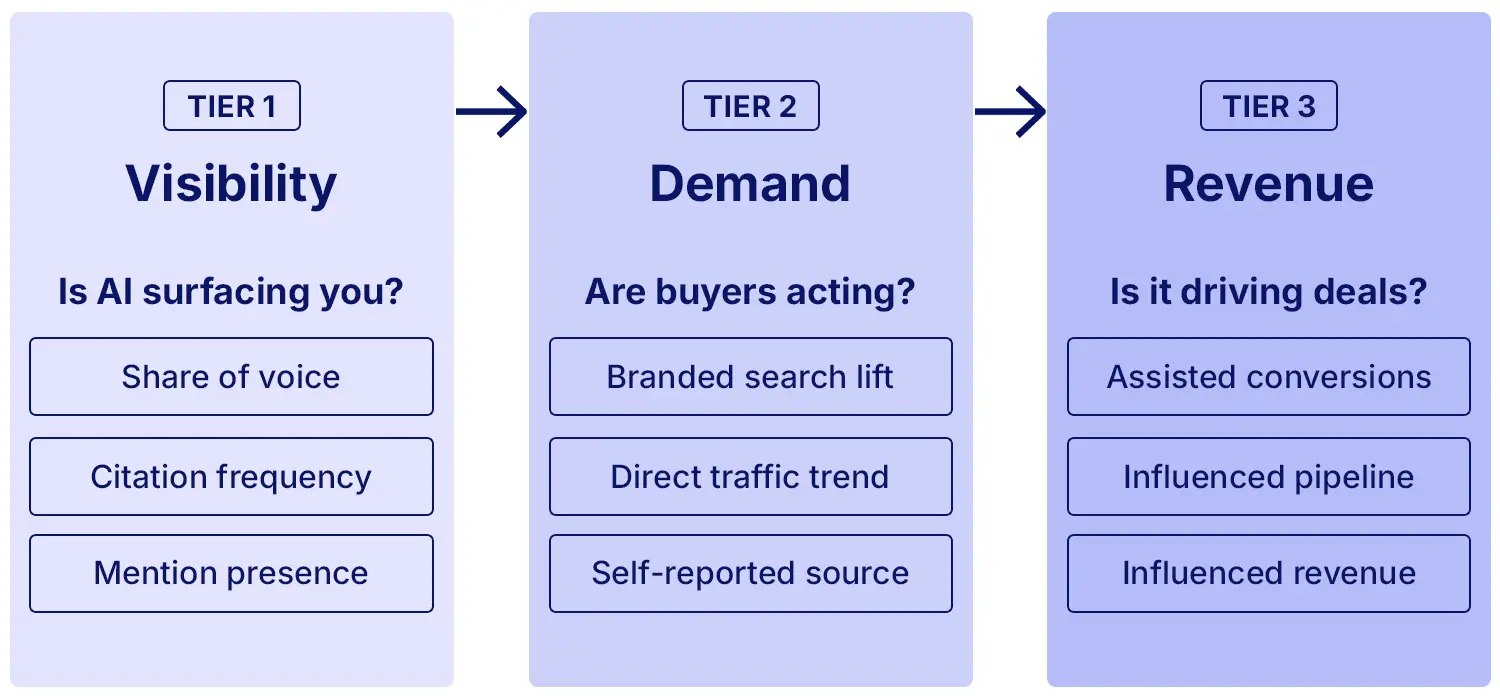
Tier 3: Revenue signals
Revenue signals are what leadership cares about most, but they are also the hardest to capture cleanly. The goal is a defensible view of how AI influences pipeline and revenue outcomes.
In practice, revenue signals show up across three measures:
- Assisted conversions: opportunities where AI played a role alongside other touchpoints
- Influenced pipeline: total open pipeline where AI is tagged as a contributing source
- Influenced revenue: the same logic applied to closed-won deals.
Across all three tiers, the CRM is the critical layer of consistency. Without a shared source taxonomy, visibility metrics, demand signals and revenue data end up fragmented across different systems — and even if each dataset is accurate on its own, the story of AI influence can’t be reconstructed.
Related: Answer engine optimization for SaaS: The partner-led playbook for LLM recommendations.
The RevOps instrumentation stack
Defining the signals is the easier half. The harder part is making sure they’re captured consistently.
CRM fields and source taxonomy
The first requirement is a standardized source taxonomy in the CRM — something like “AI Search” or “Generative Search” — available at both the lead and opportunity level. Without a discrete field, AI-influenced leads get absorbed into broader categories like “Direct” or “Other” and can’t be analyzed over time.
Longer term, UTM source tracking also needs cleaning up so that AI referral traffic doesn't automatically bucket into “Direct.”
Self-reported attribution
Self-reported attribution should play a bigger role than most teams currently give it. Fields like “How did you hear about us?” on intake forms and during discovery calls are imperfect but directionally accurate — and right now, as Richardson notes, they’re “often the only way to surface AI-influenced deals.” Treat it as a leading indicator, not a precise attribution source.
SDR workflows and call capture
Sales conversations are often where AI influence becomes visible — buyers who’ve already researched show up differently, referencing comparisons or prior vendor evaluations before the rep has said much. The standard approach is a consistent discovery question, such as “How did you first come across us?” logged in a defined CRM field.
The challenge, as Richardson points out, is consistency: “Most teams have this in their process on paper and almost nobody does it consistently.” The practical fix, she explains, is that “AI call tools can be configured to extract that answer automatically and write it directly to the CRM, so ‘I found you through ChatGPT’ doesn't disappear into call notes.”
See more: PartnerStack x Evertune turn AI search into influence through new integration.
Operational consistency
Consistency determines whether AI attribution succeeds or fails. If teams record AI influence differently across regions or tools, the dataset becomes fragmented even if each individual entry is correct. Without shared rules for source tracking, attribution models cannot produce a reliable view of pipeline impact.

Attribution models that work
Traditional attribution models break down for AI search because they’re built on touchpoint data — and AI influence often happens outside trackable systems. No single model fixes that on its own.
What works instead is running your standard attribution model for tracked interactions while maintaining a separate self-reported source field in the CRM, then analyzing both together. As Richardson explains: “When you look at pipeline and revenue cuts by that self-reported field alongside your model output, you start to see the gap — deals where the model says Direct or Unknown but the rep logged ‘found us on ChatGPT.’ That gap is your AI influence number.”
From there, other models can add texture:
- Cohort analysis tracks leads or opportunities with similar characteristics over time, which is useful for spotting whether AI-influenced cohorts convert differently.
- Multi-touch models map known interactions but are only as good as the touchpoint data behind them.
- Assist-weighted models distribute partial credit across earlier touchpoints, which helps surface influence that last-touch reporting would otherwise overlook.
- Incrementality testing, used by more mature teams, helps validate whether changes in pipeline are actually driven by shifts in AI visibility or by other factors running concurrently.
What connects all of them is the same principle: AI influence becomes measurable through comparison, not through any single model claiming to have the complete picture.
Building the dashboard
Once the models are running, the question is how to present their output. The most common mistake at this stage is building one dashboard for everyone.
Organize the dashboard by audience and cadence — who is looking at it and how often — not by which tier the metric belongs to.
Weekly: operational visibility
Weekly dashboards are for RevOps and marketing ops teams responsible for data hygiene.
Track lead source distribution, self-reported attribution coverage and volume flowing into Direct or Other. Watch for inconsistencies such as free-text entries replacing standardized AI search values.
Catching data drift early — before it corrupts reporting — is the whole point of this view.
Monthly: marketing and partnerships metrics
Monthly views are for marketing and partnerships teams tracking whether visibility is translating into demand.
Key signals include prompt-set share of voice, citation frequency, branded search lift and direct traffic to product or solution pages. This is also where self-reported attribution starts to show directional patterns in the pipeline.
Quarterly: revenue metrics
Quarterly views are for revenue leadership and finance.
Richardson’s priorities for an executive dashboard include branded search volume, AI-attributed pipeline value and stage distribution, self-reported source mix over time, win rate by source (including AI-attributed deals) and a share-of-voice metric showing how often the brand appears in AI answers for core queries.
“That gives leadership both the awareness picture and the revenue connection without overcomplicating it,” Richardson says.
What matters most at this level is the trend. A single quarter of AI-influenced pipeline is a data point. A consistent pattern across quarters is a revenue signal worth acting on.

Common data quality and governance mistakes
Even when teams define the right metrics, AI search attribution often breaks down during implementation. The issue is rarely the model — it’s how consistently data is captured and maintained across systems.
Inconsistent source naming
One of the most common issues is inconsistent source naming across teams. AI-related leads may be labeled as “AI Search,” “ChatGPT” or simply left as “Other,” depending on who logs the data. Over time, this creates fragmented reporting where the same type of influence appears across multiple categories, making it impossible to analyze cleanly.
A clear governance rule for source taxonomy is what helps prevent this drift.
Over-crediting direct traffic
AI-influenced journeys often resurface as direct traffic when users return after researching elsewhere. This leads many teams to over-credit Direct as a channel.
Teams that don’t account for this end up misreading AI-assisted discovery as brand familiarity or repeat visits rather than early-stage influence happening outside tracked systems.
Treating correlation as causation
Movement in metrics like branded search or pipeline is a strong indicator of AI impact — but it’s still an indirect signal. Without consistent CRM tagging or self-reported attribution, it’s easy to over-attribute changes that may be driven by other marketing activity or seasonal factors.
Governance and ownership gaps
The biggest challenge is often not measurement but ownership. Without clear responsibility for how AI-related data is defined, logged and audited, reporting consistency breaks down quickly.
As Richardson puts it, “Source taxonomy has to be decided once, documented and enforced before you start collecting, not after.” Without that discipline, AI influence is recorded differently across teams and tools, making any downstream analysis unreliable.
Strong AI attribution programs treat source governance as a shared responsibility across RevOps, marketing and sales operations.
You might also like: The AI-native PRM: What it means for your partner program.
What a mature AEO measurement program looks like
Most teams don’t struggle with a lack of data. They struggle with how to connect it consistently over time.
The companies doing this well, as Richardson describes them, aren’t running sophisticated attribution models. “They've built consistent data collection habits and they treat AI the same way they'd treat any other source: track it, report on it, optimize against it,” she says.
For the teams Richardson describes, that comes down to three habits:
- Clean CRM source data where AI is a defined, standardized picklist value — not something reps write into notes or dump into Other — so it shows up in pipeline reports the same way paid search or outbound does.
- A self-reported attribution question that sales actually asks and logs consistently, whether manually or through AI call tools configured to capture and write it directly to the CRM.
- A regular cadence of manually testing brand visibility in AI outputs for core queries, so shifts in share-of-voice connect back to revenue analysis.
AI search attribution is still evolving and won’t be solved by a single model or dashboard. But the teams making progress aren’t waiting for a perfect solution — they’re building the data infrastructure now, so the picture gets clearer over time.