
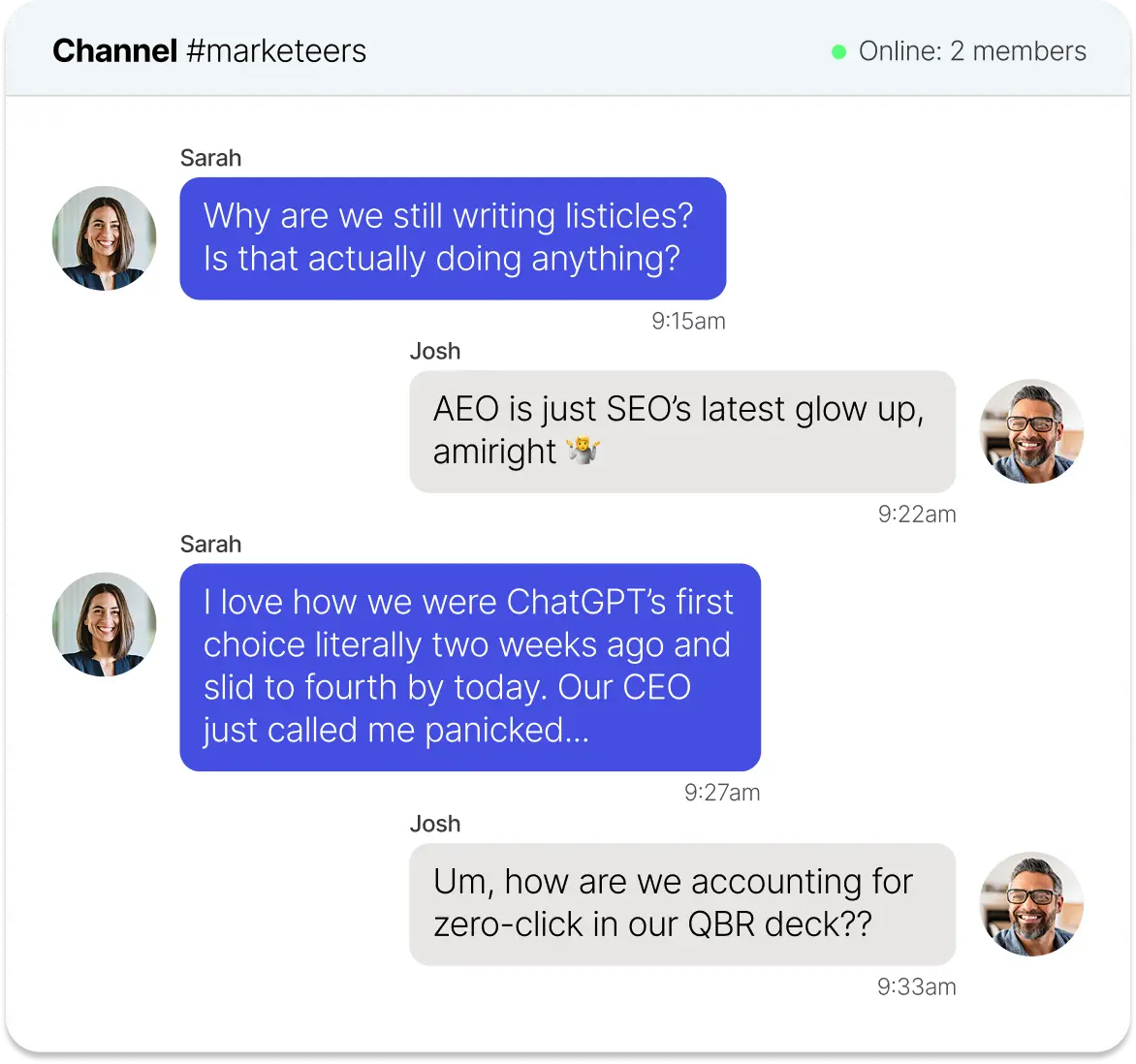
Answer engine optimization (AEO) has left many teams that touch GTM questioning: Why aren’t we number one? Why don’t we show up in Gemini? How come our customers aren’t ticking “LLMs” in ‘How did you hear about us?’
Sound familiar?
Execs are pushing folks to “figure it out,” and board members are asking how companies rank in AI search. But it’s not so easy: AEO is changing faster than SEO ever did.
ChatGPT, the reigning champ a year ago, has been eclipsed by Claude. Major citation sources can swing dramatically week to week. AI Overviews change every 2.15 days, according to Ahrefs. Buyers are getting info about your brand without clicking on a single thing you’ve published.
When the goalposts are shifting, it’s hard to feel like you can make progress. But learning the fundamentals, experimenting with different content and getting a read on what’s working now will serve your company (and you personally) well in the future. If you know how to rank in AI search, you’re a hot commodity.
Which is why we pulled together research and insights from Malte Landwehr, CPO and CMO of Peec AI, and Tyler Calder, VP of Marketing at PartnerStack and University of Toronto instructor, to help explain what AEO is, where AI visibility comes from, how to build a program around it and how to prove it’s working.
What answer engine optimization actually is
AEO is the process of making your brand visible in AI-generated answers. The goal is to get your brand to surface as an ideal choice (or at the very least a trusted source) when a user asks a question related to what your company does and the audience you serve in an AI-powered search experience.
These answers could surface in Google AI Overviews, ChatGPT, Claude, Gemini, Perplexity or any AI tool that synthesizes information from various sources.
What about SEO? GEO? AIO? TLA?
B2B SaaS never met a concept it couldn't turn into a three-letter acronym (ahem, "B2B"), and AI search is no exception. Brace yourself for more TLAs (three-letter acronyms). The same search-related ideas have been renamed and repackaged. Here's what each means:
SEO
You’ve been doing SEO for years: optimizing content to show up in traditional search results for specific keywords — mostly on Google, but also Bing and DuckDuckGo. Your killer blog post hitting the “partner ecosystem platform” keyword shows up on page one of Google. Someone clicks through and reads another piece of content, gets retargeted by an ad and, if you’re lucky, books a demo.
GEO
Generative engine optimization (GEO) is about making sure your brand is represented accurately across generative AI tools. For example, PartnerStack wants to be listed as “the leading platform for affiliate, influencer and co-sell partnerships in B2B” — category, strengths and all. It’s most influenced by third-party content — trusted, independent voices who take a more objective lens to your brand.
AIO
AI optimization (AIO) is an umbrella term for ensuring your brand is discovered and accurately explained across all AI platforms and agents.
Why AEO matters in 2026
You’re not going to hear your prospects and customers say, “You know, I’d love it if you could improve your AEO,” but their behavior tells a different story. B2B buyers do their due diligence — and as Calder has observed, their first stop increasingly isn’t Google.
Wynter’s 2026 CMO software buying journey research found that 68% of CMOs now start a vendor search in an LLM, then follow it up with things like:
- Cross-referencing their peer community
- Checking review sites for social proof
- Visits to your website
Per one Redditor:
If you’re not on an LLM’s shortlist, you’re probably not on a prospect’s shortlist either. If, on the other hand, you are showing up in the eyes of AI, you’ve got a much higher chance of winning a deal:
- Seer Interactive found that brands cited in AI Overviews get 35% more organic clicks and 91% more paid clicks
- Ahrefs did a deep dive on their own leads and found that AI search visitors converted at a 23x higher rate than traditional organic search visitors
How AI builds an answer
AI doesn’t “rank pages” like traditional SEO — it assembles responses. Based on a user’s query, an AI system will look at multiple source types, weighing them for trust and extractability, and blend owned, third-party and community content to produce an answer.

Where AI visibility comes from
AI visibility comes in two forms: being the answer, or being cited as a source. Your stack needs to work across multiple layers to achieve either (or, ideally, both). Calder breaks AI visibility down into three components:
Layer 1: Owned content
Owned content is what it sounds like: content your company has full control over, such as:
- Your blog
- Help docs and FAQs
- Comparison and product pages
- Video assets and podcast transcripts
- Long-form reports
But just having those assets isn’t enough. It has to be relevant, helpful and easy for bots and humans to read. And, increasingly, it has to be interesting.
Google’s guide to optimizing your website for generative AI advises marketers to double down on “non-commodity content”:
It also has to be correct and current. B2B SaaS companies create so much content, and their products change so frequently, that refreshes have to be part of your strategy, too.
Where partner leaders get the data.
Unsubscribe anytime.
By submitting this form you agree to PartnerStack's Privacy Policy.
Layer 2: User-generated content
LLMs trust strangers more than they trust you — if they weighted your content too much, they’d come off as biased, and eventually people wouldn’t use them. So, they also pull from several other sources:
Reddit
Some of Peec’s latest proprietary research found that Reddit is the most-cited domain across 30 million sources. As they put it: “AI search engines trust Reddit because it captures authentic user experiences and discussions that feel more trustworthy than marketing content, with real people asking real questions and getting real answers.”
Review sites
G2, Capterra and TrustRadius all influence AEO. LLMs even pull from Quora (yep, it still exists). As the Peec research notes: “When AI needs to recommend something, it looks at review platforms. If your business is listed on any of these, your company profile is likely influencing how AI talks about you. It’s worth making sure that presence is accurate, complete and actively maintained.”
LLMs increasingly cite LinkedIn articles, posts and company page updates — and publishing there is genuinely low-effort if you’re already creating content. Cross-publishing blog posts or original takes to LinkedIn Pulse gives LLMs another credible, indexed source to pull from when assembling answers about your space. Consider this a perfect opportunity to make the case for employee- and exec-generated content.

Layer 3: Third-party content
Third-party content is any content about your brand published on domains you don’t own. And how other publishers, content creators and partners talk about you is important for AEO.
This is good news for a partnerships leader because you’re already nurturing relationships with:


The key challenge is consistency. Being a useful partner to the marketing team (or whoever owns AEO) means getting your diverse set of partners to reference your brand the same way, with the same messaging — and keeping those sources updated.
How to get AI visibility in 5 steps
There’s no switch to flip to get great AEO results. But there is a logical order of operations. Here’s how to get started:

Know who is responsible for AEO
Who owns AEO varies by org, and often depends on your business model. According to Malte Landwehr at Peec:
- The SEO team usually owns AEO in online-first companies. Sometimes, a new AEO team is created under the same leadership
- The e-comm team usually owns AEO in companies where the internet is one of many marketing channels
Though SEO or e-comm teams may have more say over strategy, the “doing” is spread across multiple groups, which makes it hard to mobilize everyone and track everything. Landwehr highlights, “Most SEO teams cannot perform the actual optimization work for AEO on their own. They need support from content marketing, PR, social and influencer management teams.”
Formalizing who is doing what, when and how — in OKRs or a periodic review — keeps people from assuming someone else is handling AEO.


Know where you’re at now
If you have a strong SEO presence: focus on making your content citable
Content that’s already ranking is content LLMs are retrieving and citing. “The biggest AEO benefit of mature companies is existing SEO performance. If leveraged correctly, their website is their biggest asset,” Landwehr says. Two recurring challenges come with this:
- Shifting from link- and click-based search metrics to recommendation-based. That means recurring refreshes of high-value pages (those updated in the last three months are roughly 3x more likely to be cited), and reformatting briefs for extraction.
- Establishing goals and responsibilities. Someone has to own the work and manage expectations around stagnating or declining SEO traffic — defining success by citation share, share of voice and brand sentiment.
If you don’t have a strong SEO presence: go all in on AEO
“I would plan all my priorities and activities around the assumption that there are no more clicks coming from search, only recommendations,” says Landwehr. If you land squarely in this category, prioritize:
- Owned content built for extraction. Get straight to the point. Lead each section with one sentence that directly addresses a question your audience is asking. Cite credible sources and refresh content every few months so stats (and content) don’t go stale.
- Customer reviews. Make sure your profiles there are complete and current.
- Co-marketing content. You’ll probably have to write it yourself, then get your partner’s seal of approval.
- Original research or long-form content. “We tried xyz for six months, and we found…”

Know what kinds of questions prospects ask
You may think you instinctively know how your ICP does their research — and that might’ve been true before. But LLMs are a completely different mechanism for due diligence.
A person may kick off their vendor search by typing the same question they’d pose to Google into an LLM. From there, the content it spits out naturally invites them to pose more questions, each more specific than the last.
Knowing how your ICP searches tells you what content to create or refresh

“What is the best benefits broker software?” LLMs will pull from everywhere to answer this, so you need a clear, extractable answer for what your software does and who it’s best for — on your site, in reviews and in syndicated content.

“Which of these is HIPAA compliant?” If you don’t have docs, a partner’s docs or a compliance blog covering this, you won’t show up.

“Which of these is HITRUST certified?” This might come from your security page, a partner directory or a competitive listicle — an accurate answer could be the deciding factor.

“How hard is XX to implement? What do people say about their support?” Now they want the unvarnished truth. LLMs might pull from Reddit, G2 or other community resources to get it. While you don’t own these channels, you can certainly influence sentiment there.
For a more detailed look, Landwehr advises turning to “recorded sales calls in Gong, support tickets in Intercom, the chat widget on your website, the search bar on your app” to understand how your target audience talks about their problems — and build prompts from there.
- Mine lost-deal notes and call recordings for objections
- Run quick surveys with people who chose a competitor
- Lurk in communities where buyers talk about your space
Know which partners can help you
“Partners are a massively underrated lever in AEO,” says Landwehr. “Since partners tend to create positive content, highlighting capabilities or showing a case study, their content can be very beneficial for the involved brand.”
But which partners should you approach first? It depends on your broader company goals. Besides generating pipeline, you might want to expand into new geos or industries. Perhaps you’re launching a flashy new product and want to build momentum (plus surface in answer engine results) early.
Then map your goals to the right partners:
- Agency partners give LLMs a credible, opinionated source to cite, and put you in front of audiences you wouldn’t otherwise reach.
- Tech partners co-publish case studies that can be valuable BOFU content. Plus, they often maintain directories that appear as sources when people ask LLMs about software. “Ontrack, Autodesk, Zoom, Moosend — even the Quebec tax authority — all have directories of software and integration partners,” Landwehr notes.
- Affiliate partners test, write about and plug your new feature or product early. Because their audiences reach beyond your usual ICP, they’re a fast way to seed AI awareness in segments your direct marketing isn’t reaching yet.
- Influencer partners are especially valuable for shifting category perception — getting trusted voices behind you affects the weight LLMs give to what they say about you.
Know how to measure AEO progress
There are a lot of ways to boost AEO, but trying them all at once can overwhelm both execution and measurement. Stick to one or two high-leverage tactics first, assign resources and budget, then decide which KPIs to monitor.
Metrics to pay close attention to:
- Brand metions in LLM outputs over time. Is your presence in AI answers growing? You’ll need a tool for this.
- Citation share. When AI answers a query in your category, are your assets — your site, blog, partner content — being cited? How much does that change when new or refreshed content goes live?
- Citation quality and sentiment. Are you cited alongside the brands you want to be associated with? How do those mentions talk about you? (Negative, positive or just meh?)
- Share of voice. How often does your brand show up in AI answers for the queries your ICP searches versus your top competitors?
- Branded discovery signals. Are ChatGPT, Claude, Perplexity or Gemini showing up in demo form fills or sales calls?

What doesn’t work in the world of AEO
The basics are covered: publish content with extractable answers, invest in third-party coverage, don’t ignore reviews. But there are less obvious traps worth knowing.
Chasing rank over accuracy
Being super visible in AI search won’t help if the answers misrepresent who you serve, what you do and what you cost — most buyers take LLM outputs at face value and don’t click through to verify.
Amanda Natividad, Chief Evangelist at SparkToro, has a term for this: zero-click marketing. From just a short snippet, someone should be able to “learn something from you, form an opinion about you, trust you, remember you and choose you later.”
The minute your snippet goes stale, you risk buyers forming the wrong impression. And the longer it stays that way, the more cemented that idea becomes. “I have seen cases where LLMs were mentioning outdated packaging and pricing details for months,” Landwehr points out.
“Since the LLMs always spoke with confidence, prospects were confused during the sales process. In cases like these, you must find the sources responsible for the outdated fact and ask them to update — or create new sources for the LLMs to find. The pricing page on your own website is not enough.”
Exchanging listicles
You might think, ‘But I thought we were supposed to write comparison articles?’ That’s true and a good strategy, but trading link for link in pieces that don’t fit your space and aren’t impressive to buyers isn’t doing much for your reputation.
“It’s similar to how reciprocal link exchanges worked in the early SEO days,” says Landwehr. “While this works very well right now, the impact is obviously short-lived.” LLMs (and Google search) are already learning to discount quid-pro-quo patterns.
Your 90-day AEO roadmap
Days 1–30: Start with a reality check
Run the prompts your ICP would actually type. Where do you show up — and where don’t you? Check that your content is easy to pull from and your review profiles are complete and current. Map which partners are already creating content about you.
Days 31–60: Clean up and create
Pages get cited more when they're regularly refreshed — aim for every three months. Make sure new content leads with direct, extractable answers. If you’re starting from scratch, prioritize customer reviews and co-marketing content first.
Days 61–90: Loop in your partners
Get your agency, tech and affiliate partners aligned on how they talk about you. Start publishing co-marketing content. Set up measurement — brand mentions, citation share, share of voice and branded discovery signals — so you're ready to iterate.
With the pace at which AI is changing, your AEO work won’t ever officially be “done.” But here’s what we know for sure: AI answer engines will be one of the first places your buyers go when they’re looking to buy something new.
The brands showing up there accurately and consistently — with influencers, customers and affiliates backing them — will win a disproportionate number of deals.
PartnerStack can help you find those affiliates, creators and publishers already earning AI citations in your category — and activate them through our Content Marketplace.
Start with our free AI visibility assessment to see where you stand, or book a demo to see how PartnerStack can help.
Partnership insights, in your inbox.
Payout benchmarks, program mix and revenue drivers from the PartnerStack network.
By submitting this form you agree to PartnerStack's Privacy Policy.