Here’s an idea that’ll spark either worry or inspiration for any B2B marketer: what if the first stop in vendor research for today’s software buyers is no longer Google, but an LLM?
That’s the shift that PartnerStack and Profound dug into on August 11, when PartnerStack’s Chief Marketing Officer, Tyler Calder, and Profound’s Founding Marketing Engineer, Nick Lafferty, teamed up for a webinar titled Win AEO with Partners: From Invisible to Cited.
Both bring unique perspectives to the conversation: Calder came up through the SEO and agency world and has watched a shift like this play out before. Lafferty runs Profound’s own AI visibility program internally and has also built partner programs firsthand. Together, they broke down what’s actually happening in AI search right now, and what B2B brands should be doing about it.
As Calder puts it: “That’s the big opportunity… making sure that you are not just making the shortlist, but you are protecting and defending your territory, making sure you’re not getting pushed out by others.”
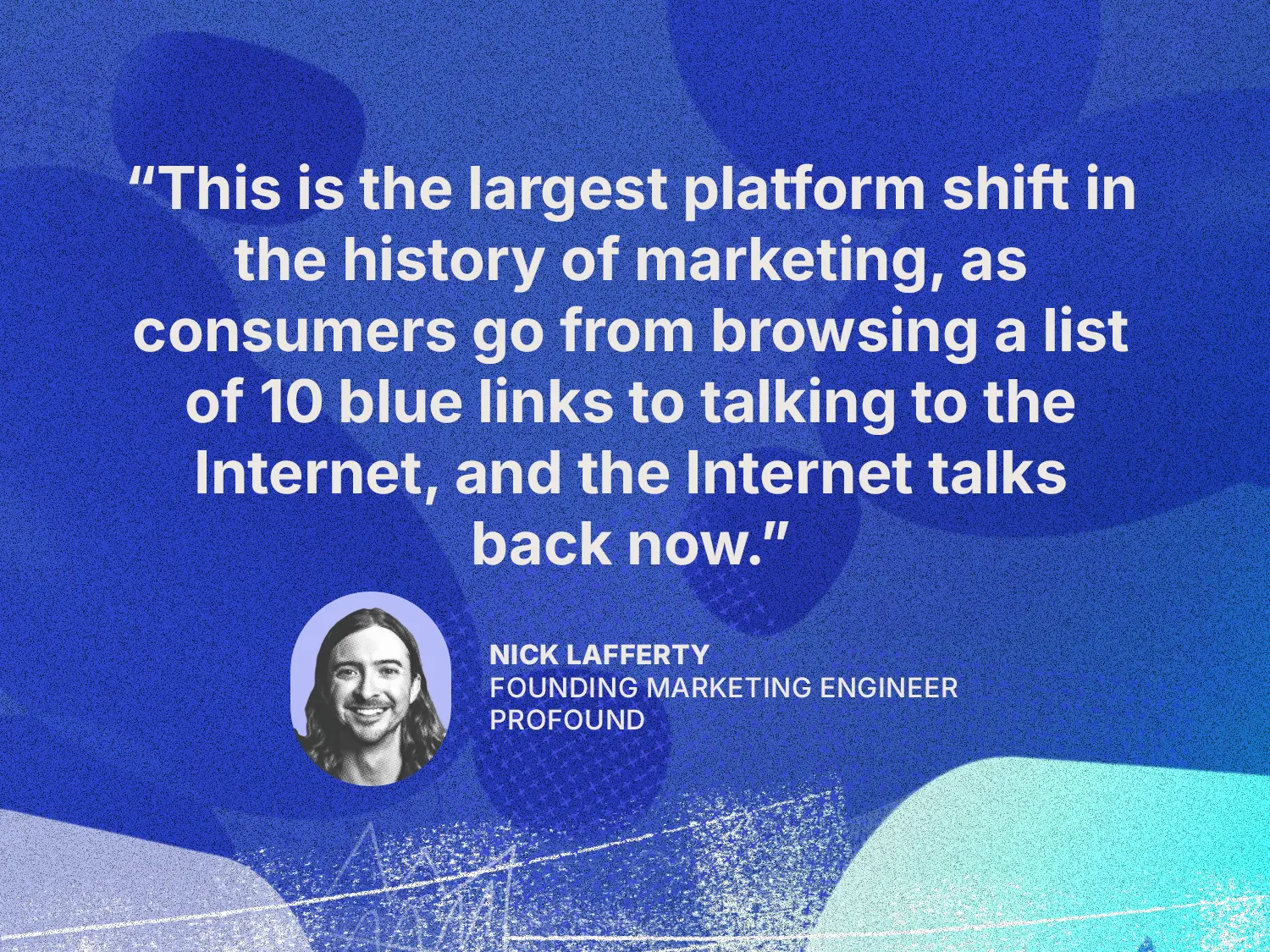
Lafferty puts the broader shift in even starker terms: “This is the largest platform shift in the history of marketing, as consumers go from browsing a list of 10 blue links to talking to the Internet, and the Internet talks back now.”
Here are five of the biggest takeaways from their conversation.
1. Third-party content — not your own website — drives most AI visibility
B2B marketers have been pouring resources into their own websites for years, focusing on better copy, better structure, better SEO. All of that still matters, but according to Profound’s data, it’s no longer where the majority of the battle is being won.
85 per cent of brand mentions in AI search come from third-party domains — think: industry publishers, blogs and creator content, review platforms — not owned content.
Their data also found that in order to win AI search, you need content partners at scale: 97 per cent of AI citations come from long- and mid-tail publishers, not The New York Times or the Forbes-tier outlets most brands assume they need to chase.
As Calder puts it, “There’s what you say about yourself, and then there’s what everybody else says about you. And we see the LLMs really leaning into that third-party content as sort of validation that you’re as good as you say you are.”
So how do you actually show up in third-party content?
Lafferty lays out two paths: work with existing partners and publishers to earn placements (hint: this is the approach at the core of the PartnerStack × Profound integration — more on this later), or build your own third-party source entirely, the way HubSpot did when it acquired The Hustle.
See more: Why third-party citations win in AI search.
2. Closing the gap takes a systematic loop: identify, activate, measure
So how do you actually go out and get that third-party content? In the webinar, Calder shared how the PartnerStack × Profound integration functions as a sort of flywheel, with each platform handling a distinct step:
Step 1: Identify — Profound finds the gap
Surface where your brand is missing from AI answers: which prompts you’re absent from, which domains are getting cited instead of you, and where competitors are showing up in your place.
Step 2: Activate — PartnerStack closes the gap
Take that list of high-value, uncited domains and match them against PartnerStack’s partner network to recruit and mobilize the right partners to close each gap.
Step 3: Measure — Profound proves it moved
Track whether those new placements actually drive visibility lifts, and surface the next gap to go after.
To show what that looks like in practice, Lafferty built an outreach agent live during the webinar, start to finish, in minutes. It pulled Profound’s own citation data, scored and tiered the top domains, checked them against PartnerStack’s partner network and drafted a personalized outreach pitch for each one. The workflow replaced something Lafferty says used to be entirely manual and tedious: reaching out to “dozens or hundreds of partners” by hand.
For a simplified starting point, PartnerStack’s Content Marketplace lets you browse vetted partners and publishers, see pricing and start conversations directly, with no custom agent required.
Related: Introducing PartnerStack’s Content Marketplace: Activate AEO data and drive AI visibility at scale.
3. You can — and should — measure incremental lift from partner placements
One of the sharpest audience questions from the webinar centered on incremental lift: “How can brands prove that an affiliate drove incremental AI citations and thus pipeline, hopefully, rather than just assuming that that would have come anyways or that visibility already existed?”
Here, Lafferty broke his answer into two scenarios, depending on the starting point. The clearest case is when your brand isn’t mentioned at all on a page that’s already being cited: once you’re added, every future citation that page earns can be attributed to your new visibility. From there, he pointed to three concrete ways to measure the lift:
- Referral traffic from the placement should move from zero to a non-zero number, since you weren't mentioned or linked on the page before.
- Your visibility or citation score should increase since you’re now present on a page that was already being cited and wasn't previously counting toward your brand.
- “How did you hear about us?” This is a field that Lafferty argues that more B2B companies should have on their sales forms. When a prospect names the specific publication or placement, that’s a direct, first-party data point tying the placement to pipeline.
Together, these three signals give you a reasonably complete picture of whether a specific placement was worth the investment, without needing perfect, single-source attribution.
4. AEO isn’t a solo sport
Ask Lafferty where AEO programs tend to go wrong internally, and his answer is immediate: “I think the biggest mistake I see people making is treating this as a single-player exercise instead of a team sport.”
Lafferty notes that most AEO programs get handed to whoever was already running SEO: one person, now managing an entirely new discipline on top of their existing job. But that setup doesn’t match how AI visibility actually works.
Since the majority of citations come from third-party placements rather than owned content, a single SEO person optimizing their own website can only ever influence a fraction of what’s shaping the brand’s AI visibility.
“It’s not just your SEO person optimizing all the content on your own website,” Lafferty says. “It’s how does your SEO person work with your partnerships, your affiliate person to say, hey, I found this listicle. I want to get listed on it. How do we work with this partner to make that happen?”
That collaboration doesn’t stop at partnerships. Lafferty also pointed to PR (for earned media placements) and product marketing (for accuracy and to ensure AI isn’t describing your product incorrectly) as two more functions that should be pulled onto the team.
The good news, Lafferty says, is that this typically isn’t a hard sell internally. “Everyone wants to help you kind of solve this problem. So it’s just how do you make it more of a team sport and get buy-in for that.”
5. Speed favors the nimble, but quality wins long-term
Good news if you’re a smaller brand: speed is on your side. Lafferty cited Profound research showing the median time it takes for a new article to be cited in ChatGPT is six to seven days.
For large, high-authority sites, it can happen even faster. “I have personally published content, and I’ve seen it be cited in less than 48 hours,” Lafferty says. “And I’ve seen it be cited the same day for really, really large companies who have, you know, tens of thousands of pages. It can happen way faster than you’re used to for Google search.”
But size cuts both ways. Bigger companies may have more authority, but they also have way more red tape, and publishing new content can take months to clear internal approvals. Smaller companies don’t carry that kind of baggage. For them, Lafferty says, “speed is your competitive advantage.”
Speed isn’t a license to flood the zone, though. On the topic of AI-generated content, Lafferty was clear about the difference between AI-assisted work, where a human stays in the loop, and fully AI-generated content with no human review. Readers can spot the latter — whether it’s a blog post, a LinkedIn update or a Slack message — and people are growing “allergic” to it. And, if a human can spot it, AI models will start discounting it too.
The same logic applies when refreshing old content for AI search, Lafferty says: “I will die on this hill. Have 50 of the best pieces — [the kind] you would send your mom, your grandma or your professor at university and be proud of. Fifty of those is way better than 500 ‘AI sloppy’ blog posts.”
Calder, who came up through the early SEO era, has seen this before:
“There was a period of time where mass-produced content worked, and it worked really, really well to drive ranking. And then it didn’t. And when it didn’t, your site disappeared from Google. You were penalized. The climb back was very challenging.”
Lafferty thinks AI search may be headed for its own version of that kind of reckoning, the AI-search equivalent of Google’s infamous algorithm updates in the early 2010s.
“We haven’t seen our first algorithm update in AI search yet, in the scale of, like a Penguin or a Panda kind of update in Google. And I think we’re due… I think it’s coming.”
See more: How AEO is like early SEO — and why first principles will win.

Where to start
Okay, so where should a brand actually begin when it comes to AI visibility? Lafferty’s advice is to start close to home.
“Clean up your on-site,” he says. “Clean up your house first, because you have the most control over that. But also recognize that that’s not the only surface area. And, if you’re going to win in your category, that’s not good enough.”
Once your own site is in order, the next stop isn’t a stranger’s website. It’s polishing your own scattered footprint in all the places your brand describes itself. Think: old social accounts, forgotten YouTube channels, outdated bios.
“I guarantee you someone here works at a company that has inconsistencies there,” Lafferty says. “And if your own brand can’t consistently describe what your company is on your own social platforms, how do you think AI search is going to do it consistently?”
From there, he recommends starting simple with friendly partners, existing customers and easy first placements, then scaling up from those wins.
If there’s one thing to take from this webinar, it’s that nobody’s solved this yet. AI visibility is still early, messy and fast-moving — a lot like SEO was 15 years ago. The brands paying attention now will be ahead of it later.
Want to learn more about how the PartnerStack × Profound integration works? Read more here, or book a demo.