When someone asks ChatGPT, Perplexity or Gemini which HR software to buy, which CRM tool is best suited for their business model or which project management tool is worth the price, your brand either shows up or it doesn’t.
According to Forrester’s 2026 Buying Survey, 994% of B2B buyers have used or plan to use generative AI in their buying process. AI-generated answers are quickly becoming the first touchpoint in how software gets discovered, evaluated and shortlisted. They’re what buyers see before looking at your website, requesting a demo or booking a sales call.
The brands winning in that moment aren’t winning because they’ve published more content on their own site. They’re winning because the right publishers, creators and reviewers are writing about them, and AI models are citing those sources when buyers come asking.
So the question isn’t whether third-party content matters. It’s whether you’re doing anything about it. That’s why we built the Content Marketplace: to help brands find and activate the publishers already shaping AI-generated answers in their category, with upfront pricing, a structured workflow and payment handled natively.
Why third-party content is key to AI visibility
AI models like ChatGPT and Perplexity don’t generate recommendations from thin air. They pull from the web — specifically, from sources that have established authority on a given topic. That means industry publishers, review platforms, comparison sites, newsletters and creator content carry enormous weight in determining what gets surfaced and what doesn’t.
According to an AirOps report on third-party sources and brand discoverability, 85% of brand mentions in AI-generated answers come from third-party domains. And perhaps counterintuitively, it’s not the major media outlets that dominate those citations. Research from AEO platform Profound shows that the blogs, newsletters, YouTube channels and niche review sites that deeply understand a specific category or audience are the ones AI models trust and cite most often.
This is a shift from traditional SEO. “SEO was about links and ranking,” says Roger Sheppard, President of Slashdot Media. “AEO is about reputation and being cited. If your brand is not showing up in the sources AI models trust, it will not show up in the answers they generate.”
The question brands now have to answer is how to influence content they don’t own.
Read more: How AEO is like early SEO — and why first principles will win.
The activation gap between AEO data and influence
Most marketing teams know how to monitor their AI visibility. Tools like Profound, Evertune, Scrunch AI and AthenaHQ can tell you which publishers are being cited in AI-generated answers in your category. They surface citation gaps, domain-level opportunities and URL-by-URL visibility data.
The problem is what happens next.
Knowing which publishers are driving citations and actually working with those publishers to get your brand mentioned in their content are two completely different challenges.
What we consistently heard from customers before building the Content Marketplace was that the workflow was entirely manual: find a cited URL, try to identify the right contact, send a cold pitch, wait, negotiate, agree on terms and handle payment outside any system they were already using. In the best cases, it took several back-and-forths to reach an agreement. In the worst cases, they never got a response at all.
“Working with publishers to improve AI visibility typically involves gathering information about who’s being cited, finding publisher contact information and emailing back and forth to figure out the details,” says Kevin Randolph, Partnerships Manager at Nutshell.
Nick Cotter, founder of partnerships agency Growann, describes the process as a “grind” that could take weeks to execute. “I had to manually find publishers, chase contacts, negotiate placements and handle payments across email and spreadsheets,” he says.
Multiply that process across the dozens of publishers you’d need to meaningfully move the needle on AI visibility, and the manual work becomes a bottleneck. The AEO insight is there. What’s needed is a way to work with publishers at scale.
Introducing the Content Marketplace
Now, there’s a way to influence third-party content at scale. The Content Marketplace is a hub within PartnerStack where brands find and activate publishers and creators who are already influencing AI-generated answers in their category.
Publishers and creators list their properties, including websites, YouTube channels, newsletters and LinkedIn pages, with specific offers and upfront pricing. Brands browse, filter and send a content request directly inside PartnerStack. The full workflow, from first message to commission payment, is handled in one place.
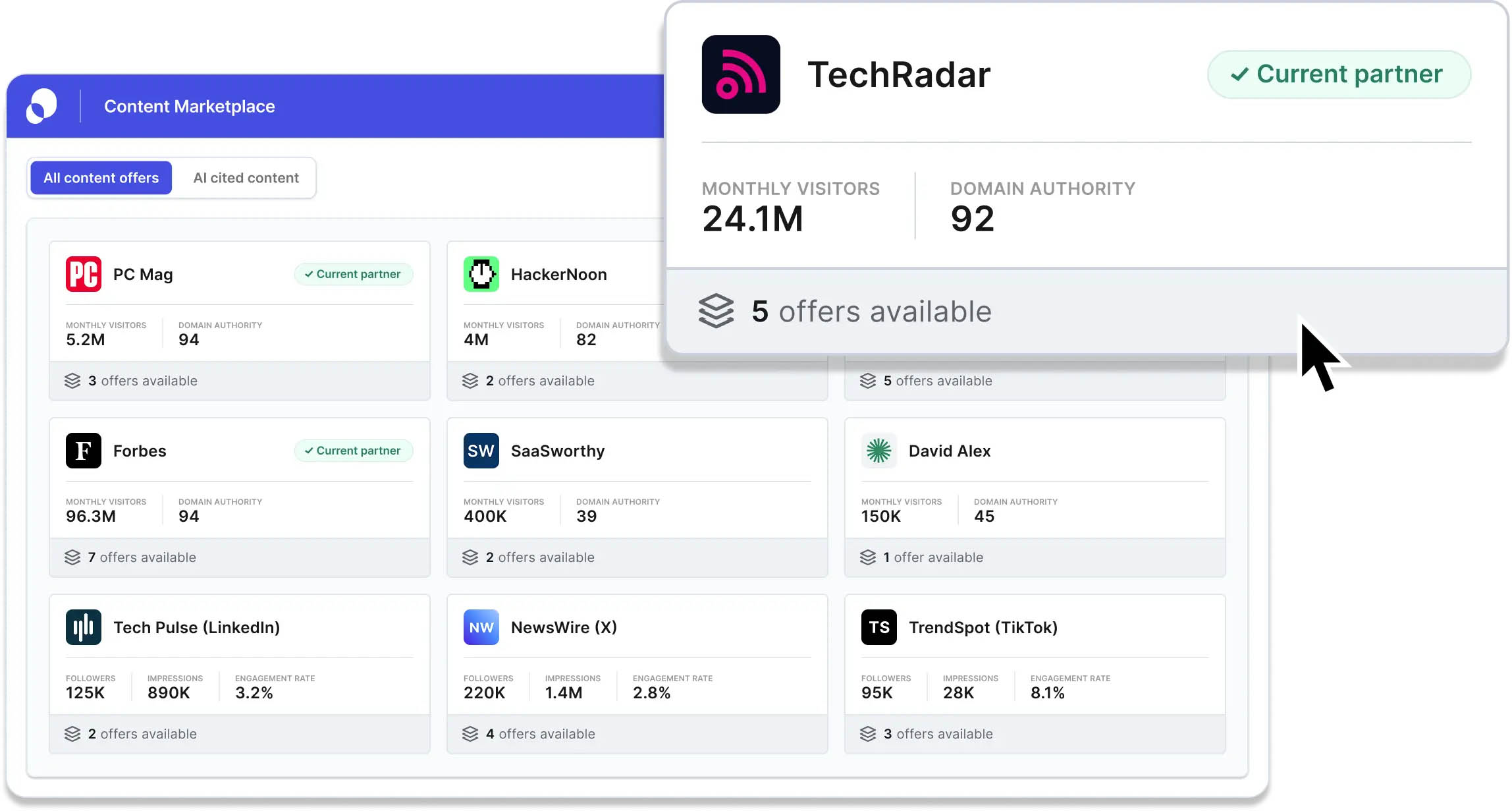
The Content Marketplace is built around a simple idea: the publishers that matter most for AI visibility should be as easy to work with as any partner in your program.
What we noticed as customers started using the marketplace is that their approach is highly targeted. Rather than scrolling through every available listing, brands are zeroing in on five to 10 partners that match their specific citation data or fit their category based on domain authority and relevance.
“The marketplace is incredibly intuitive and makes sourcing high-quality content partnerships seamless. It’s clearly positioned to drive LLM citations, increase brand visibility and generate real revenue,” Cotter says.
How the marketplace works
Browse by channel, content type and budget
Every listing in the Content Marketplace includes the partner’s property type (website, YouTube, newsletter, social and more), available offer types (listicle mentions, sponsored videos, blog posts, product comparisons and more) and upfront pricing.
Network badges show partner quality and network status at a glance, so you know immediately whether a partner is already in the PartnerStack Network or new to your program.
You can also filter by price range to stay within budget, property type to focus on the channels most likely to drive citations in your category and content type to match your campaign brief.
The marketplace makes it easy to expand your reach to new channels. “I was surprised when I saw a roster of YouTubers on the Content Marketplace,” says Victor Moen, CEO of Affilial.com. “From first glance, we found multiple relevant YouTube partners we didn’t come across in our own prospecting.”
Send a request in one step
When you find a partner that’s the right fit, you send a request directly inside PartnerStack. You can include a content brief, link to specific URLs you want updated and add any context the partner needs. The partner receives an email notification and an in-platform message. No cold outreach, no chasing a contact form.
Kevin Randolph at Nutshell says he’s seen an immediate difference. “PartnerStack’s Content Marketplace takes all of the information you’d normally have to gather on your own about potential placements and puts it in one place,” he explains. “Being able to reach out to publishers right from the marketplace speeds up the outreach process and makes it much easier to get in contact with the right person.”
Collaborate and confirm the details
A conversation thread attached to every request lets you and the partner align on timing, scope and any specifics before the work begins. Once the partner accepts, a commission is automatically created in Hold status and the partner is added to your program.
Partner delivers, you approve, payment is released
After completing the content placement, the partner submits proof of delivery: a URL and supporting evidence. You review and approve it, then the commission moves from Hold to Approved and is placed on your next invoice. No manual invoicing. No separate payment tools. Everything is handled natively in PartnerStack.
This is the bridge between insight and activation. Your AEO monitoring tool tells you who’s driving citations. The Content Marketplace is how you work with them.
What publishers and creators say
The Content Marketplace isn’t just a better experience for brands. It makes partnerships simpler for publishers and creators, too.
“The marketplace allows brands that are already interested in high-quality content to connect with us directly, showcasing our full catalog of articles up front and simplifying communication around placements,” says Kobi Cohen, CEO of Work-Management.org.
Nikola Djuric of DesignRush, meanwhile, believes the marketplace removes the biggest bottleneck in publisher-brand partnerships. “Instead of chasing leads, both sides can focus on creating content that converts,” he says.
On the creator side, Lili Marocsik, founder of AI Tools for SMEs, says the marketplace brings order to what was a chaotic process. “As a small business owner myself, I find the templated structure a real time-saver,” she explains. “I can define my offer once and get in front of a much wider range of brands, ones that might never have found me otherwise.”
Going further: The AI cited content tab
For brands that have already invested in AEO monitoring tools, the Content Marketplace goes one step further.
The AI cited content tab sits beside the main marketplace view and surfaces a table of the top publishers already being cited for your brand, pulled from citation reports you’ve uploaded from tools like Evertune, Profound, Scrunch AI or any compatible platform. Data is displayed at the URL level, with a direct link to each property.
Where a marketplace listing exists for a cited partner, you can request a placement directly from that row in one click. Where it doesn’t, you can reach out to that partner directly from the same view, without running a full recruitment flow.
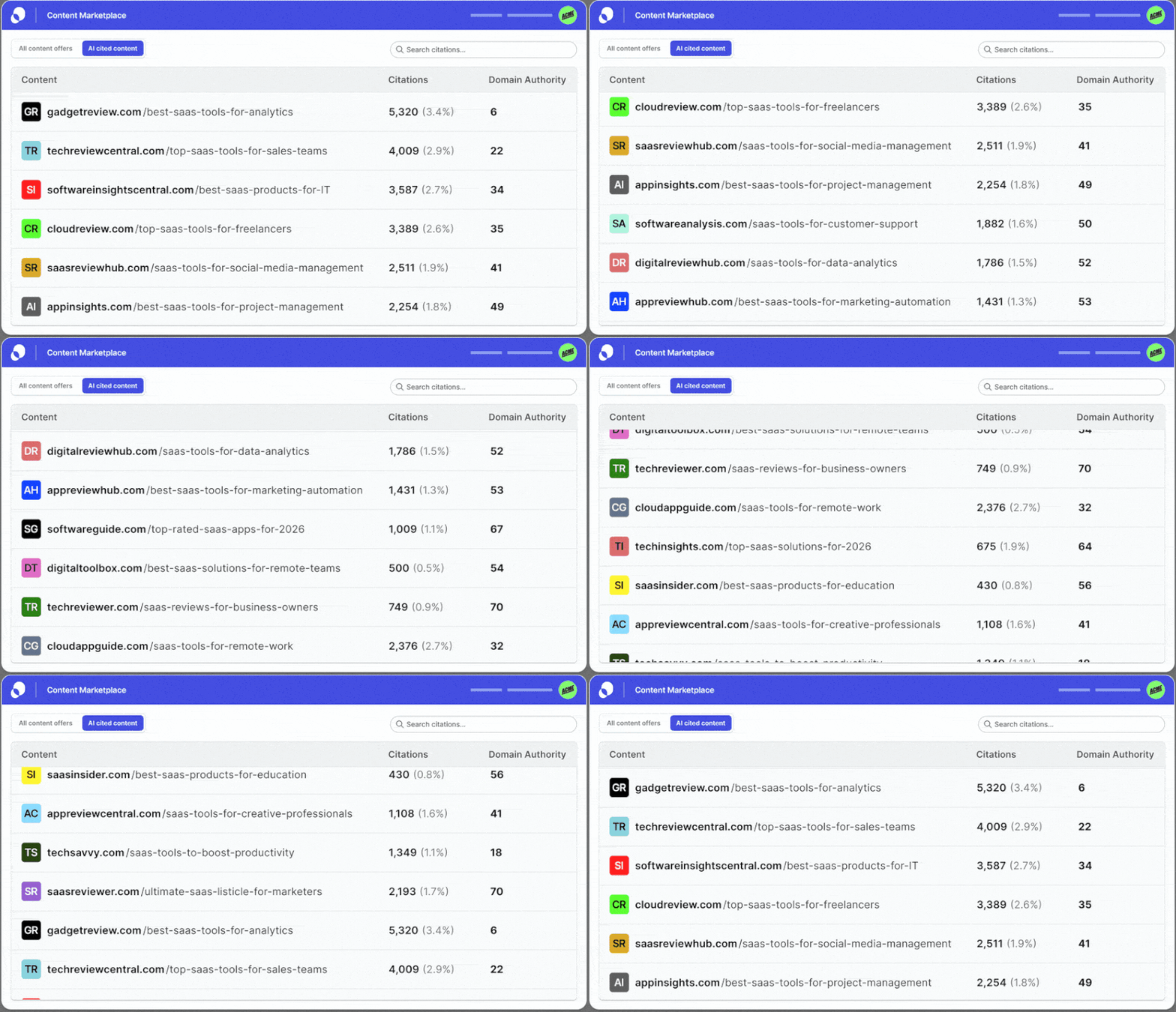
This feature reflects what customers actually needed most: the ability to go from knowing which publisher is driving citations to contacting them directly, without switching platforms, running a recruitment flow or starting from scratch. The AI cited content tab makes that a one-step action.
Axel Guiral, Marketing Lead at Consio.ai, found this tool particularly helpful. “I used the AI cited content tab a lot,” he says. “It was super easy to find relevant marketing publishers because of it. I love the idea of having everything in one view.”
Why this matters now
The window for building AI visibility won’t be open indefinitely. The brands that establish strong third-party content coverage now, across the long and mid-tail publishers that AI models actually cite, will be harder to displace as AI-generated answers become more entrenched in how buyers research software.
There’s a structural shift happening on both sides of the marketplace. Publishers are seeing click volumes drop significantly as LLMs surface answers without driving traffic back to source URLs. Some that we’ve spoken to have reported click traffic declines in the range of 30 to 70%.
At the same time, publishers know their content is being cited in AI-generated answers and are increasingly asking for upfront compensation for placements they know will drive results. Brands, meanwhile, want more third-party content written about them precisely because they know it’s what gets cited. The Content Marketplace is where these two needs meet.
The marketplace is also a practical starting point. Find the publishers producing relevant content in your category. Agree on a flat fee, an affiliate arrangement or a hybrid model. Get content moving. Measure what gets cited.
Get started
The Content Marketplace is live on PartnerStack. Browse publisher listings, filter by channel type and content type, and start activating the partners who are already shaping AI-generated answers in your category.
Explore the Content Marketplace.