Running partnerships means outsourcing some of the sales or marketing motion.
If we have a marketing partner, for example, that means I want someone external to handle my Google ad spend for us. Or if we’re outsourcing to blog and website partners, that means we want to outsource our organic traffic or our content team. If it’s a reseller program, we’re outsourcing sales, demos and integrations. Whatever the use case, you’ll be working with people who don’t necessarily do things the way you would.
There’s lots of different partners out there. And maybe what they’re doing fits with what you want. But being flexible and having an open mind means you have a lot more opportunities available.
That means that empathy (being open to other perspectives) and experimentation (being open to trying new things) are more than nice-to-haves in partnerships. They’re key drivers of success.
Let’s take a look at how empathy and experimentation support resilient ecosystems — based on my experience with PartnerStack’s Customer Success team.
The human side of partnerships
Sometimes partnerships program managers don’t understand what their partners are doing, or what their struggles are or what bothers them.
Say you have a program with a marketing partner who optimizes and runs your Google ads. So you’ve outsourced your ad spend to them. That’s great.
Now say your boss tells you that you’re changing the budget, so you have to change the commission structure to 10% less than what you had been paying.
Of course the marketing partner is going to be frustrated. They’ve likely already spent money on ads, and now you’re telling them you’re going to change the reward structure. So they’re out a whole bunch of money, because they’re not going to get the return they thought they would on what they spent in advance.
Or say you have a program where a partner is sending you leads, but they’re already in your CRM, so you say you’re not going to pay. That partner is also going to be frustrated, because there’s no way they can know what you already have in your Salesforce.
If there are always secret rules popping up, partners are going to disappear.
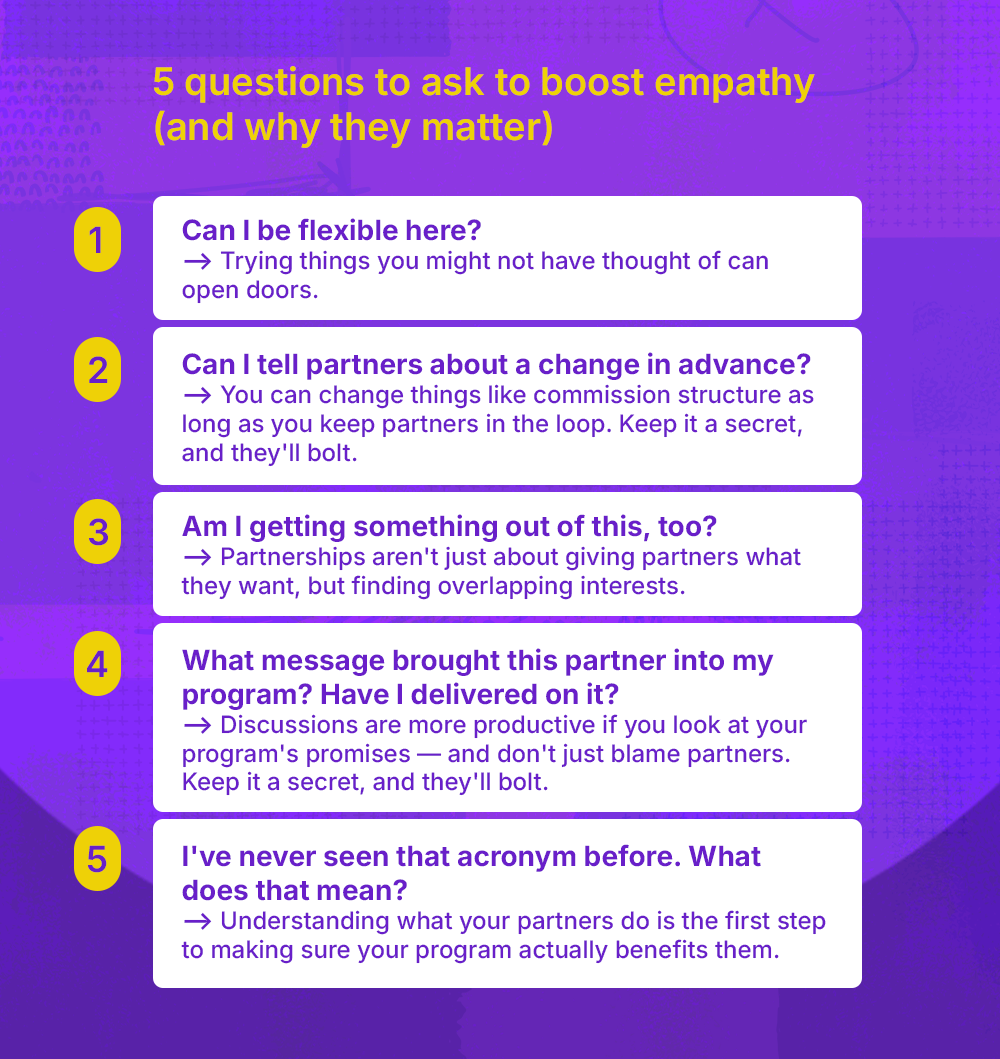
That’s where empathy comes in. Look at the situation from partners’ perspective — or better yet, open the conversation.
If a change needs to be made to your commission structure, give them a couple months’ notice, so a marketing partner can adjust their spend accordingly. If you need to reject a lead, tell your partner why.
Lots of partners are willing to work with programs as long as they know what’s happening. It’s better to put things out in the open and let partners be proactive, or try to find a middle ground.
Read more: How partners enable the 6 GTM motions you need.
Why experimentation matters
Partnerships evolve, which means no single playbook works for every motion.
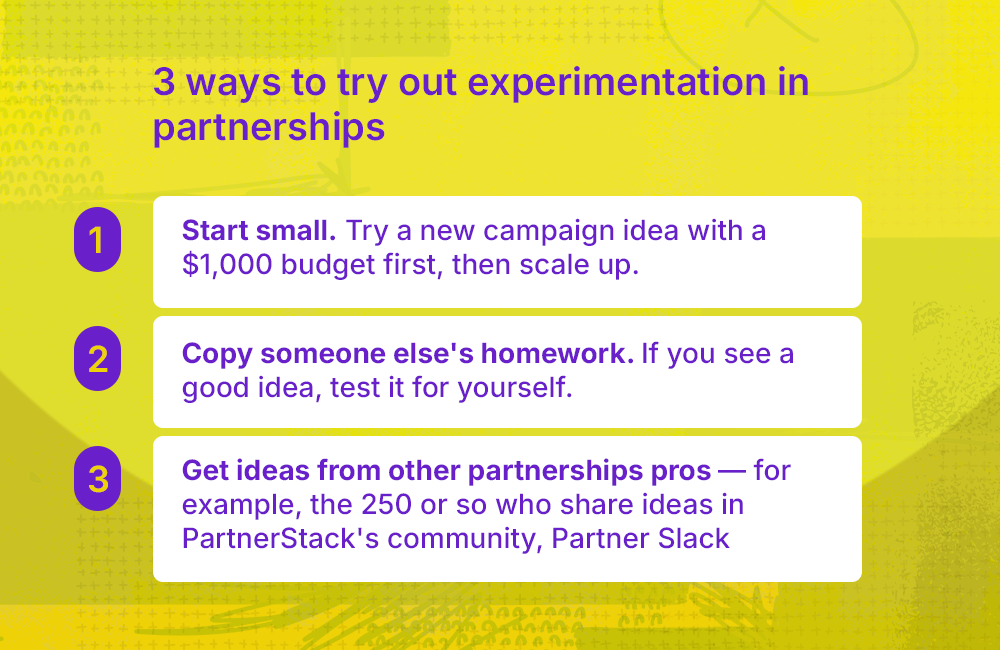
Experimentation can help you out here. You can try something out with a small budget, take a calculated risk and, if it works, scale it up.
Ex-Pancake Tanner Braden tried this — as an experiment, actually. He reached out to all his partners and said, “If I had $1,000 to give you, what would you do with it?”
He basically invited them to pitch. Then he took these pitches to his team, and brought the numbers to his boss, and got some budgets for partners to do what they wanted.
But he also talked about what he was doing on our Slack channel, PartnerSlack. So he posted to say, “I’m running this experiment right now. I’ll let you know how it goes.” He shared the process and the results so others could learn.
In fact, some of our vendors were able to copy his homework — they ran their own experiments and shared what they learned on PartnerSlack and LinkedIn. That inspired even more vendors to take their own calculated risks in turn.
It’s easy to set up experiments within PartnerStack. You can put caps on how much spend a trigger allows. So you might set up a cost-per-click campaign with the safeguard of a spend of only $1,000.
You might also like: Why pilot programs are a best practice for B2B SaaS.
Balancing empathy with accountability
When we talk about empathy, it’s not just about giving people whatever they want.
The job of a partnerships professional is to find the Venn diagram of your company’s goals and the partnerships goals — to find where they overlap. This means you need to explore and understand what your partner is doing and how they’re making their living, in order to find that overlap.
It’s easy to get lost in the pressure. Often a partnerships professional owns revenue, so you’re always going to have people saying, “Show me the numbers.” What then happens is the partnerships manager starts to panic and pings their partners to ask, “Why aren’t you selling more?” or “How come you stopped sending me traffic?”
But that’s the worst way to engage. Instead, if you’re the partnerships manager, you need to ask yourself:
- Why is this partner here?
- What message or promise brought this partner into my program?
- Have I delivered on it?
The truth is, if partners are sending you traffic but you can’t close the deal, it’s not entirely the partner’s fault. You might need to improve your funnel or take other steps to improve the conversion rate. Once you’ve asked yourself the questions above, you can open a conversation with the partner.
That discussion could address things like:
- Could we send traffic to a different landing page?
- Can I give you a discount code to help improve conversions?
- What would help you spin up more campaigns?
A very common message is, “Hey, you should join my program. I give a 20% revenue share. Let’s make some money!”
So partners join and send some traffic, but they don’t make any money, so they stop being active or leave your program. It’s up to you as the partnerships manager to deliver on that message — or else partners won’t stay.
How empathy and experimentation reinforce each other
Partnerships can help open a lot of opportunities, because as long as you’re outsourcing things, you don’t only need to do the things you’ve thought of already.
In fact, if you have too rigid a structure and you’re unwilling to listen to a pitch, you could very well be missing out on some really interesting opportunities.
For example, I’ve worked with a company that makes ads for smart TVs. They’re specifically targeted to households, because those televisions are connected to the same WiFi as everyone’s phones, and we can tell what people have been looking at on their phones.
But some program managers aren’t empowered — or flexible — enough to take unusual opportunities. They may insist on sticking to, say, blog partners and giving them a certain rev share.
Another example is a company that does targeted ads in podcasts, which is a huge opportunity because 80 to 90% of Americans listen to podcasts.
Maybe as a B2B software vendor, you’ve never thought about running podcast or radio ads. As customer success managers, though, we’re always trying to empower partnerships managers to take things up the chain. We want to make sure you have the resources to grab your boss’s ear. The key is that you have to be willing to hear the pitch out — and try something new.
See also: 10 star B2B SaaS partner programs in the PartnerStack Network for 2026.
Lessons from the field
Here’s what I’ve learned about what it looks like to manage partnerships with empathy and experimentation.
Partner personas exist for a reason
Every partner you work with is worth your time. But you don’t need to start having deep heart-to-heart conversations with every single one in your roster, or you’d never go home.
A number of partners don’t even want to get on a phone call. They just want their stuff to work.
This is where partner personas can help. Your CSM can help you figure out:
- What kind of partner it is (i.e., a blogging partner)
- What that kind of partner cares about
This way, you have a starting point to know what kinds of conversations to have, and then from there to learn a little bit more about your partners.
Use automations to keep things moving
The 80-20 rule applies to many partner programs, where the top 20% of the program drives 80% of the revenue. I’ve even seen it more exaggerated than that, where it’s the top 5% driving 95% of the revenue.
That’s where you want to put your empathy and energy. If you lose one of your heavy hitters, it can be a significant chunk of your program. So you really want to maintain your relationship with them, rather than chasing everybody and trying to play therapist.
The automations PartnerStack offers can really help keep the home fires burning for partners who are kind of steadily chugging away. And that can free you up to build rapport with your best partners.
The nightmare scenario for a program manager is to say, “This is my top partner, and I have no idea what they do.” But I’ve seen it happen.
Don’t make promises you can’t keep
When your company is small, you may need to buy your way into market share. But it’s never a good idea to boost a fledgling partnerships program by offering a lifetime commission.
That’s the equivalent of offering your marketers equity. That’s when CROs start coming over in four years to ask why you’re paying 20% revenue share on a five-year-old customer. And that’s when you have to pull the lever in the ejector seat and kick everyone out of the program — all because you overpromised.
Again, empathy isn’t about giving partners everything they want. It’s about finding the overlap between their interests and yours. Your CSM can help you be strategic about attracting partners with a valuable program — while putting guardrails in place to protect your bottom line.
You can always ask questions — or ask your CSM
If you don’t know what something means, ask.
You don’t have to turn yourself in to your boss in handcuffs and say, “I don’t know what I’m doing here.” But if someone uses an acronym you don’t recognize or talks about a concept you’re unfamiliar with, you can ask them to back up and explain.
You can also ask your CSM. We often have access to additional data, so we can help paper over the information gaps. For example, I might say, this person belongs to 12 other programs, and they’ve answered surveys on those programs. Let’s get some of those answers for you.
We can also help tighten up your processes going forward. Maybe you start collecting more information about your partners when they join the program so you have that data for later.
What we can’t do is answer what you don’t ask. If you never tell me that you don’t know what this or that partner does, I can never help you figure it out.

Get support and ideas from other partnerships pros
A partnerships position can be very lonely. Unless you’re in a very big company, you might be the only person in your organization who’s running the partnership motion.
That’s where the PartnerStack community can help. We have Partner Slack, a channel where vendors can join and communicate with each other, and help each other out. Now you have 250 coworkers who are all in the same boat.
So that’s where you can talk about things like how to talk to your boss to get a little bit of budget for experimentation.
Bringing empathy into your partnerships program
Partnerships is a relationship business. Ultimately, it’s about listening to people and giving them the chance. If you’re not trying to understand their motivations and challenges or staying open to their ideas, you’re missing out.