Enterprise companies have a lot to gain from strategic partnerships. The right partners can help them drive revenue, enter new markets and reach customers more efficiently than they could alone. And these companies are well-positioned to succeed: they have the brand power to attract major channel partners, the resources to support them and the teams to execute across regions.
But scaling a partner program in a large organization is often harder than it should be. Internal blockers — caused by the company’s own size and structure — make it difficult for teams to stay aligned and for the program to deliver results.
We spoke to Adam Faber, Senior Customer Success Manager at PartnerStack, who has helped mid-market and enterprise companies resolve internal challenges that stall partnership growth. He shared:
- Common blockers that prevent enterprise companies from growing their partnerships
- How these blockers impact the business and partnership success
- Practical ways to remove each blocker so your program can scale and deliver results

Blocker 1: Regional budgets that prevent global partnerships
Partnerships in large companies are often managed by multiple teams, with each team owning a specific region and its own budget. That structure works fine for local partnerships. But when you try to run a global program, it becomes a blocker, because the partners you want to work with operate globally, not according to your internal structure.
Faber saw this firsthand with a global company that split its partnership program by region. One person owned North America, another owned EMEA and another owned APAC, and each had their own budget and performance targets.
The problem came when the company tried to work with major media publications. According to their policy, if a partner drove 100 customers, the company would only pay for the ones located in the region that signed the deal. This created immediate friction. These partners had global audiences and weren’t willing to deliver worldwide value for partial reward, so they walked away.
“This was a huge blocker for our partners, many of whom operate globally. They didn’t care about the company’s geographical blocks, so they wouldn’t work with them,” Faber says.
To resolve this issue, the regional department heads agreed on a cost-sharing approach. Since there was no global budget, they pooled their resources: if a partner drove 100 customers from different regions, each region paid for its share. Faber compares this approach to splitting a restaurant bill: everyone chips in based on what they consumed.
The fix worked, but it took months to align internally, putting the program behind schedule and delaying business growth. If the company had set up a global partnerships budget from the start, it could have launched faster, kept the strategic alliances happy and avoided losing a quarter to internal coordination.
You might also like: Why pilot programs are a best practice for B2B SaaS.

Blocker 2: Undefined roles that delay strategic partnerships
With multiple teams involved in a partner program, it’s easy to overlook key responsibilities when no one is clearly assigned to them. This leads to missed tasks that can slow down the program or cause it to fail altogether.
As Faber puts it, “Organizing your program so that you know who’s in charge of which partner is important. If it’s not one specific person’s job, then it’s no one’s job.”
For example, high-stakes deals often get escalated to a VP or executive because frontline team members may not have the authority to approve the partner’s requested terms. The negotiation might go smoothly, but the problems usually start after the agreement is signed.
Senior leaders typically aren’t operating in the partnerships platform every day. They don’t have time to manage implementation and may not know what needs to happen next, like setting up tracking, confirming attribution rules or making sure payouts are configured correctly. Without a clear handoff to someone closer to the work, the partnership stalls.
Faber recalls one instance where a VP negotiated a deal and agreed to pay a large partner a certain amount. But because no one was assigned to handle the partner after the negotiation, the tracking was never set up correctly, and for weeks, nothing was recorded. From the partner’s perspective, it looked like they had done the work, and the company was refusing to pay. As a result, they stopped working with the company entirely.
“When a big partnership doesn’t launch properly, that partner, you’re going to lose that trust and you might not get it back again,” Faber warns.
The solution? Outline every role in the program and assign an owner to each one. Never assume that a task is being handled just because it was discussed in a meeting. Also, loop in the right people at the right moments. If a deal requires VP approval, keep the program manager (or whoever runs day-to-day partnerships) in the thread so they can implement what was agreed.
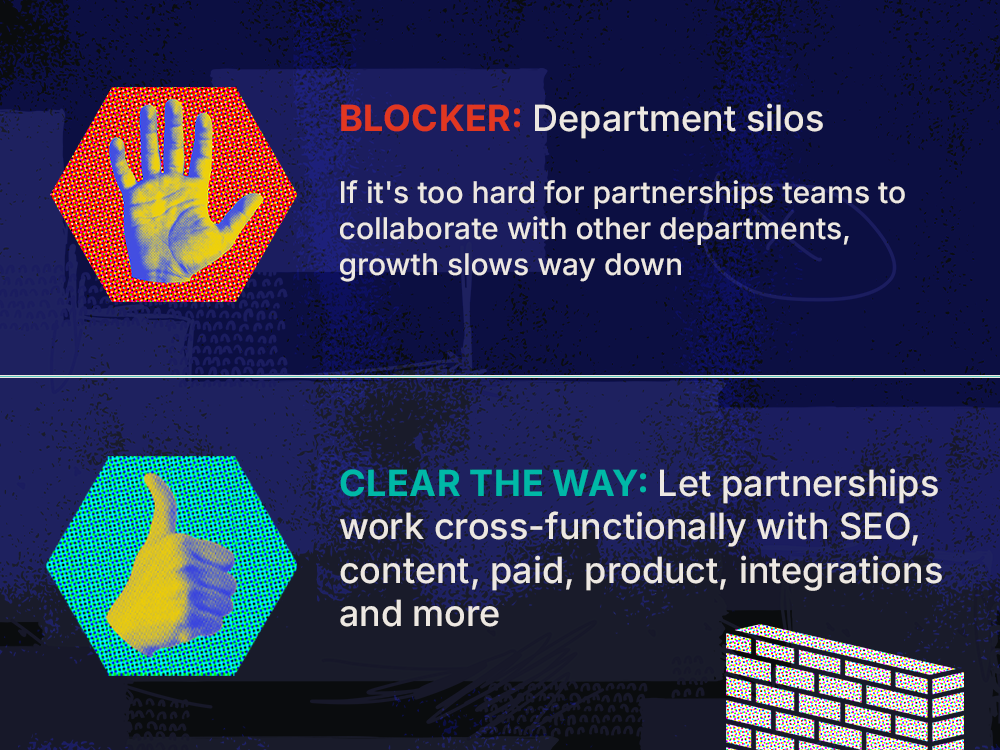
Blocker 3: Department silos that limit growth
In large organizations, partnerships often sit under one department — usually marketing or sales — and stay focused on their own KPIs. This limits what the team can achieve, as there are a lot of opportunities for growth to be found in collaboration with other departments.
For instance, many partnership teams avoid anything related to paid marketing because there’s already a performance marketing team managing that channel. But that separation can be a missed opportunity. In some cases, the partnership motion can drive better outcomes than paid ads, because partners bring credibility and third-party trust.
Faber points to comparison ads as an example. A paid search team might run ads like “PartnerStack vs. Impact,” but if those ads lead to a page hosted on your own website, buyers may not trust the content. At the consideration stage, they want validation from independent sources. A comparison or review hosted on a third-party site helps with building trust and is far more likely to convert.
To avoid this blocker, don’t keep the partnerships team in a silo. Maintain open communication with teams like SEO, content, paid, product and integrations to understand their goals and find areas to collaborate. Once you start working cross-functionally, share performance regularly so other teams know what’s working and are more likely to support future initiatives.
PartnerStack makes this easier with reporting dashboards that show partnership performance. You can schedule reports to be emailed automatically to stakeholders, so leadership and other teams stay updated, without needing to log into the platform every time.
See also: Everything you need to know about partner relationship management software.

Blocker 4: Misalignment with leadership priorities that weakens partnership impact
Company executives often have a few priority initiatives they’re pushing hard in a given quarter — a new product launch, a shift into new markets or a new positioning play. Adam calls these “side quests.” The blocker is that partnerships teams often aren’t aware of these priorities early enough, so they continue running their programs as usual and miss the opportunity to support the C-suite and contribute to company-wide goals.
To resolve this, meet with your executives or department heads each quarter to understand what they’re prioritizing, then identify where strategic alliances can help you move those goals forward.
Say leadership is trying to improve visibility in LLM-based search, which means third-party websites take on more importance than your own blog. In that case, partnerships can support the initiative by working with the right channel partners on activities like sponsored placements or paid insertions on reputable third-party sites to build credibility outside your owned channels.
See also: Navigating SEO: implications for B2B partnership content strategies.

Blocker 5: Lack of engineering support that delays partner launches
Many enterprise programs stall during onboarding or launch because partnerships can’t move forward without engineering support, and the engineering team isn’t always resourced or incentivized to prioritize partner work.
This is one of the most frustrating blockers because everything else might be ready, but you can’t move forward because you’re waiting for the developers, who already have a full sprint planned. As a result, you can lose weeks or months sitting in the sprint queue. And some partners may lose interest and shift focus to competitors with faster, more responsive infrastructure.
The fix? Pull engineering in early. “If you’re making changes or getting started and need to integrate, make sure you have the resourcing from your company’s developers, so they can integrate, or make the changes needed on an integrations side,” Faber says.
Before you commit to a launch date, confirm what technical work is required and when it can realistically be delivered. Then share realistic timelines with partners so you don’t damage trust and mutual respect later with delays.

Remove blockers to build stronger, more successful partnerships
Enterprise companies have a real advantage when it comes to strategic partnerships: the brand credibility to attract major channel partners, the resources to support them and the reach to drive business growth across regions. But as we’ve seen, scaling partnerships inside a large organization often breaks down for various internal reasons.
When you remove these blockers — regional budgets, unclear role ownership, departmental silos, misalignment with leadership priorities and tech support delays — you build a strong partnerships program that delivers better results.
For best results, Faber encourages companies to put someone with real partnerships experience in charge of program operations. “Because you’re a big organization, it doesn’t mean your team has partnerships knowledge,” he says. He often sees companies assign the program to a marketing manager or sales lead, only to find out they’ve never run partnerships before.
Instead, invest in expertise early. That might mean hiring someone who has done successful partnerships before, bringing in a consultant for the first six months or working with an agency to help launch the program while your internal team learns the ropes. In Faber’s words, “it’s a really good use of funds to set things up correctly from the start, rather than doing it on the fly and then fixing it in year two.”
And when you’re ready to scale, having the right infrastructure matters too, which is where PartnerStack comes in. PartnerStack helps you manage every aspect of your partner program in one place instead of juggling multiple tools for affiliates, referral partners and influencers. And because PartnerStack grows with your business, you can start with the partnership motion you need today, then expand into new partner types over time, without having to shop for a new platform every time your program evolves.
Want to see how PartnerStack can help you grow partnerships? Book a demo today.