
When you’re presenting to your CRO, it’s tempting to lead with the big numbers: new partners that joined this quarter, deal registrations submitted, referrals that came through the door. Until they start asking more pointed questions:
Are those new partners in the regions and verticals we’re targeting?
How many of those deal regs closed?
What’s the churn rate on partner-sourced customers?
Are we seeing upsell and cross-sell in those accounts?
Suddenly, the numbers don’t seem that big. Because what CROs actually care about is bookings, retention and expansion. And if you can't draw a straight line from your partner program to each of them, you're not telling a story they want to hear.
To get into that mindset, we sat down with our own CRO, Mike Head. Here are 5 ways to tie your program directly to the KPIs that keep revenue leaders up at night.
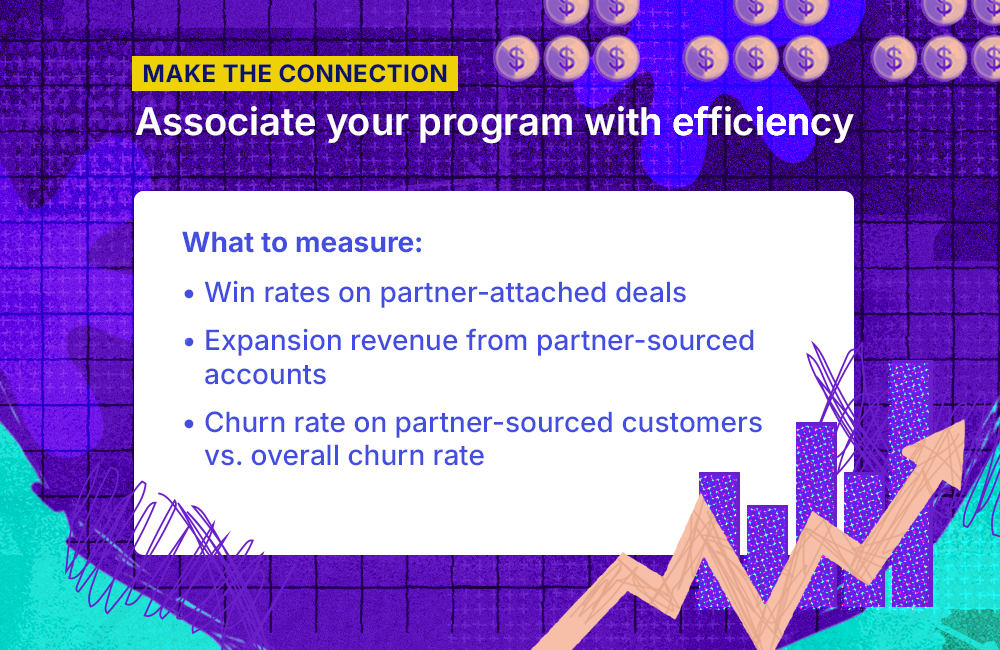
1. Associate your program with efficiency
Partnership teams can do a lot with very little. Get four or five partners making warm intros to great logos, and you’ve got yourself a high-functioning program at a very low CAC (especially compared to what your marketing counterparts spend to generate similar pipeline).
Plus, you can point out that:
- Partner-sourced deals tend to close faster. End customers trust partners’ opinions.
- End customers become stickier. Implementation partners boost adoption, and integration partners embed your product in users’ day-to-day workflows.
As Head explains, “It’s way less expensive to retain and expand customers than it is to acquire new ones. Prove your program is doing that, and partnerships won’t just be another GTM tactic they can pull money away from.”
Metrics to track
- Win rates on partner-attached deals (easy to automate if your PRM syncs with your CRM) → more closed deals, more ARR
- Expansion revenue from partner-sourced accounts → more products, more ARR
- Churn rate on partner-sourced customers vs. overall churn rate → fewer cancellations, more net dollar retention
Keep in mind
Partner programs don’t start showing their efficiency right away.
“You’ve got to learn to manage the conversation. If your CRO is under the impression that they’ll see an influx of bookings within 90 days of standing up your program, you’re set up to fail,” Head says.
His advice is to break your KPIs down into smaller milestones so you can show progress against them every week, every month, every quarter. “That’s how you can mitigate against the stop and start of partner programs.”
You might also like: Core revenue wins your partnerships team delivers (and why you should care).
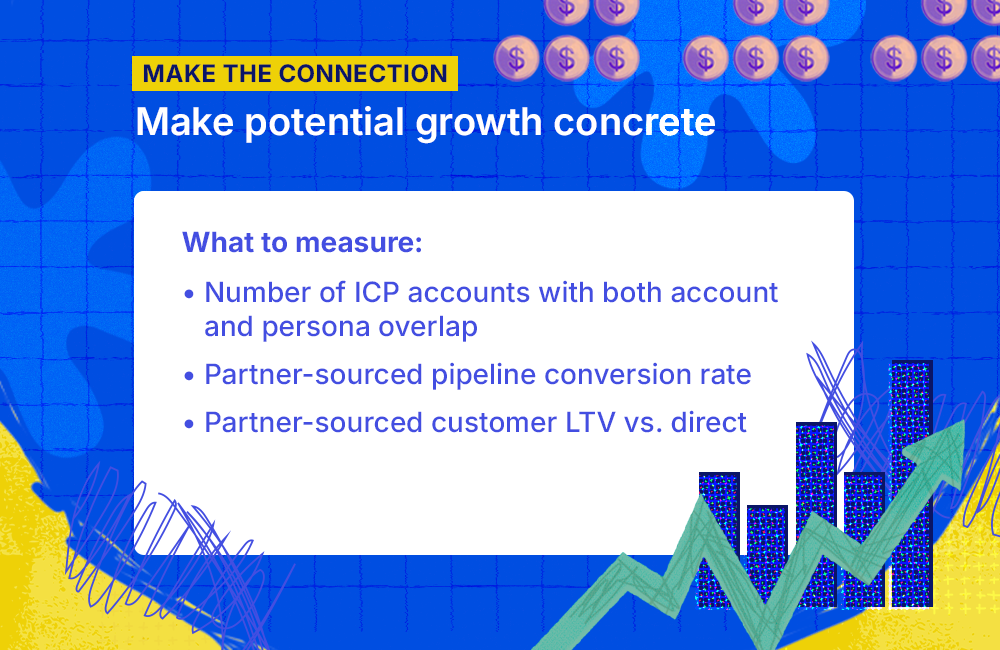
2. Make potential growth concrete
Companies start partner programs because they want to grow. But if you let just any partner into your program, you’re not going to grow in the right direction.
Most partner leaders try to show they’re being strategic through account mapping: lots of partner account overlap = lots of pipeline. That’s a reasonable starting point, but it’s not always true.
“You might have 500 accounts in common with a partner, but if they’re working with the IT buyer and you sell to the marketing buyer, that overlap isn’t going to turn into real pipeline,” Head explains.
What really matters to the CRO is that you know, at the highest level of the funnel, what accounts have persona overlap.
“Once you have that universe, you can start to truly analyze what your partner opportunity will be,” Head says.
“How much of it could I expect to convert into pipeline? How much of that could I expect to convert into bookings? What's the LTV? That gives you a way to forecast and set goals you can defend.”
Metrics to track
- Number of ICP accounts with both account and persona overlap → higher potential ARR
- Partner-sourced pipeline conversion rate → higher actual ARR
- Partner-sourced customer LTV vs. direct → higher NDR
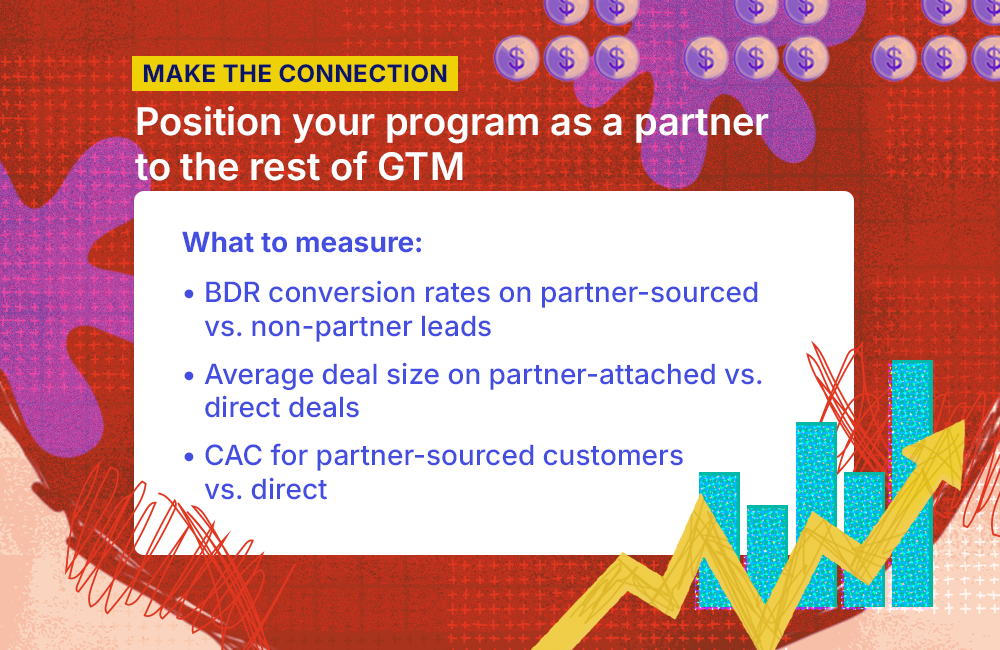
3. Position your program as a partner to the rest of GTM
Yes, you should get credit for influencing deals, but don’t fight for it. It’s a losing game, and it makes you look small.
“If all you’re focused on is influenced revenue, you’re shooting yourself in the foot,” Head warns. “It’s just going to feel like noise and devalue the program overall.”
Instead, come in with proof that your program is making your peers’ jobs easier, whether that’s:
- Getting a top integration partner to feature you in their onboarding flow
- Co-authoring a “state of” report that marketing uses in outbound sequences (and that boosts your AEO, more on that next)
- Having a partner’s CSM recommend you during a customer’s annual review
Metrics to track
- BDR conversion rates on partner-sourced vs. non-partner leads → better conversion means greater efficiency
- Average deal size on partner-attached vs. direct deals → bigger deals mean higher ARR
- CAC for partner-sourced customers vs. direct → reducing bottom line, increases ARR
Keep in mind
Single-sourced, last-click attribution creates infighting. Work with RevOps to set up multi-touch attribution and comp structures that incentivize collaboration, not channel conflict.
See also: 5 blockers to growing partnerships in big companies — and how to overcome them.

4. Frame partnerships as a distribution advantage
These days, anyone can vibe code anything. Which means there’s a flood of software in the marketplace — and they’re all fighting for the attention of your ICP.
Partners can set you apart. Their word, their content, their relationships mean something in the eyes of your target audience that your marketing alone can’t manufacture.
“The more you can think about partners who have access to your ICP and being an entry point through them and the preferred technology, the more you can mitigate distraction from new entrants,” Head emphasizes.
LLMs amplify that reach. Tech partnership FAQs, co-written posts, agency content that mentions you by name — all that gets your product more visibility.
Metrics to track
All of these are signs of efficiency and higher potential ARR:
- Inbound leads attributed to co-created content
- Brand mentions in LLM outputs over time (you’ll need a tool for this)
- Times ChatGPT, Claude, Perplexity or Gemini come up in ‘how did you hear about us?’ form fills or sales conversations
- Partner-sourced pipeline in new geos or product categories (as a result of content specifically geared toward those markets)
Keep in mind
Marketing development funds don’t have to go toward events and swag. Ask your partners if you can use the funds they’ve given you for co-created content like listicles, LinkedIn thought leadership and joint landing pages — and offer them the same options in return.
Read more: AEO for partnerships: how to shift your content strategy to rank in LLMs.

5. Use your partner base as a window into the market
Most partner teams are so laser-focused on signing big-name partnerships that they miss what’s right in front of them.
“You can’t just go after strategic partnerships. It takes a long time to get in front of the right person. Even then, it may never work,” Head shares. “The more diverse you go, the more likely you are to find a couple of wins versus just honing in on a few big partners.”
A diverse partner base also gives you something more valuable in the long term: a pulse on the market. “The more diverse your partner base, the more you can start to see trends that are happening within your ecosystem, like the rise of GTM engineering agencies, for example,” Head says.
Where partners are adding customers in certain verticals, where investment is picking up, and where it’s starting to fall off are valuable data points your CRO (and the rest of the company) may not be getting elsewhere.
Metrics to track
- Pipeline and bookings by partner tier → shows where ARR is coming from (and where you could get more)
- Partner customer growth by vertical, QoQ → signal of where your next ARR opportunity could come from
- New partner type emergence over time → leading indicator of where new bookings might come from and a heads up for sales, marketing, even product
Make your program impossible to ignore
Partner programs are being tested right now. AI is changing how software is built, bought and recommended — and CROs are scrutinizing every line item in their GTM budget.
The programs that stay standing are the ones that can tell a clear, credible story that maps directly to the KPIs CROs care about: NDR and ARR.
PartnerStack helps you make that case with attribution reporting that reflects the complexity of B2B deals and shows up where the rest of your revenue data lives: your CRM. Book a demo to see it yourself.